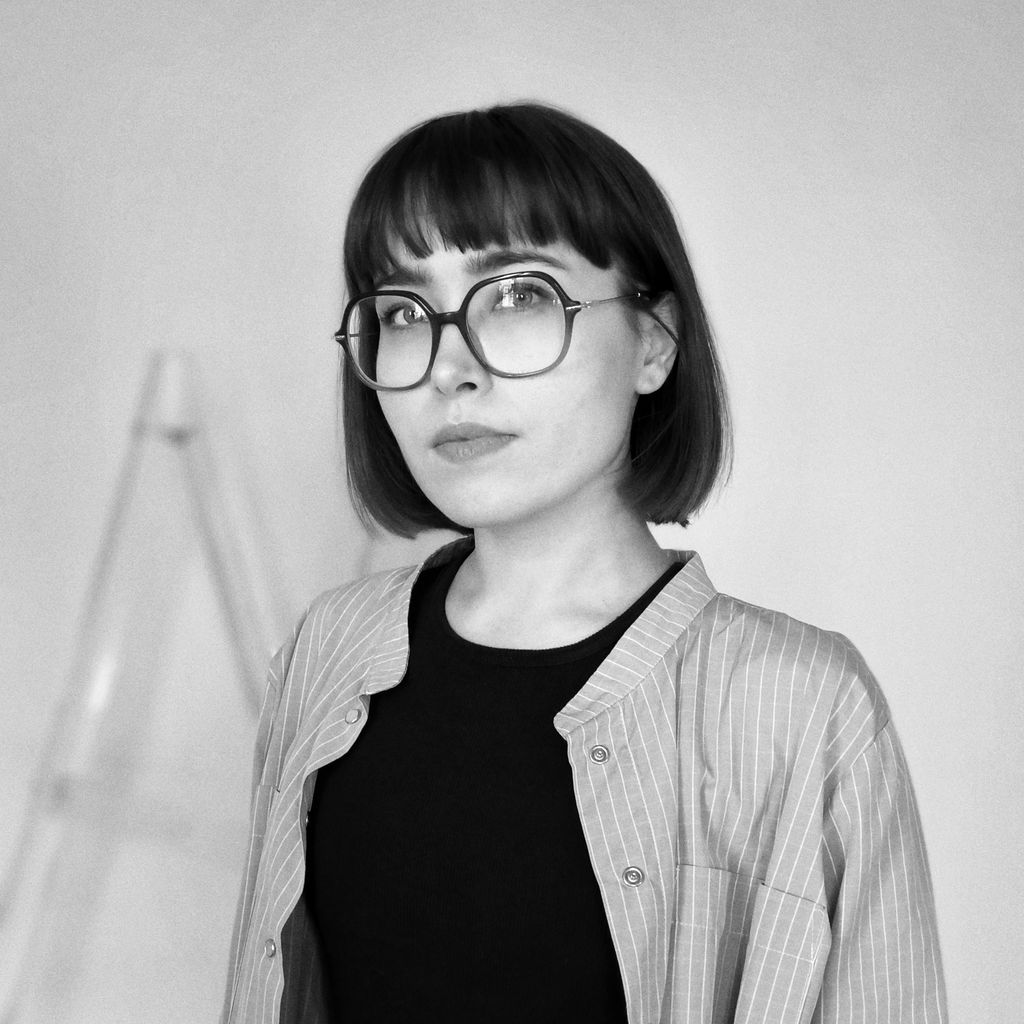
This artist was a resident of cohort 1, 2025-26.
Daria Goncharova, a Russian-born interdisciplinary artist based in Belgrade, combines a research-based approach with a critical engagement with the social and infrastructural systems that shape everyday life. Her work has been presented internationally and has received support from the Goethe-Institut’s Culture Moves Europe grant and the European platform IN SITU.
The residency in Kalba became a methodological testing ground for the Interline Chronicles, a participatory, research-based project that explores what I call ‘interlinear space’, a shared structural condition that connects text, urban space and textile practice. In my textual practice, I examine this term through networks of notes and marginalia left by different readers. Though these traces are usually considered secondary to the ‘main’ text, they reveal processes of interpretation and informal authorship that are excluded from the authoritative narrative. Similarly, in urban environments, I see interlinear space in transitional or abandoned places. I am interested in how these spaces shift the perception of the city beyond its tourist-oriented image, revealing the less visible, everyday layers of urban life.
The final parallel comes from textile practice, specifically lining. It supports, stabilises and enables form without visual dominance. Across these three registers, I view interlinear space as a place where the usually hidden, marginal or private becomes visible as a shared structure.
During my residency at Sharjah Art Foundation, I initially conceived the project as a community reading group focused on multiple texts and annotations forming a collective textile diary. As the project evolved, I adapted the methodology, transitioning from a structured group format to individual encounters based on ‘The Life of the Forest’, Chapter 11 of Anna Tsing’s The Mushroom at the End of the World. Working in the UAE, I became particularly aware of how much communication can happen indirectly, through small gestures. I began inviting people to meet me in various locations, such as Kalba Library, the mall, the mangroves and recreational areas. Discussions about space often turned into conversations about belonging, sometimes revealing a deeply personal dimension. Alongside these meetings, I paid attention to Kalba’s urban fabric, particularly fenced-off or vacant areas between residential blocks and active public spaces. This interest led to a temporary installation in one of these sites, which currently functions as the project’s preface.
The long-term goal of Interline Chronicles is to develop a flexible methodology based on collective reading and annotation practices that will lead to a series of interconnected textile diaries.
 OFF
OFF