Photo by Daniel Schäfer. Image courtesy of Hauser & Wirth Menorca.
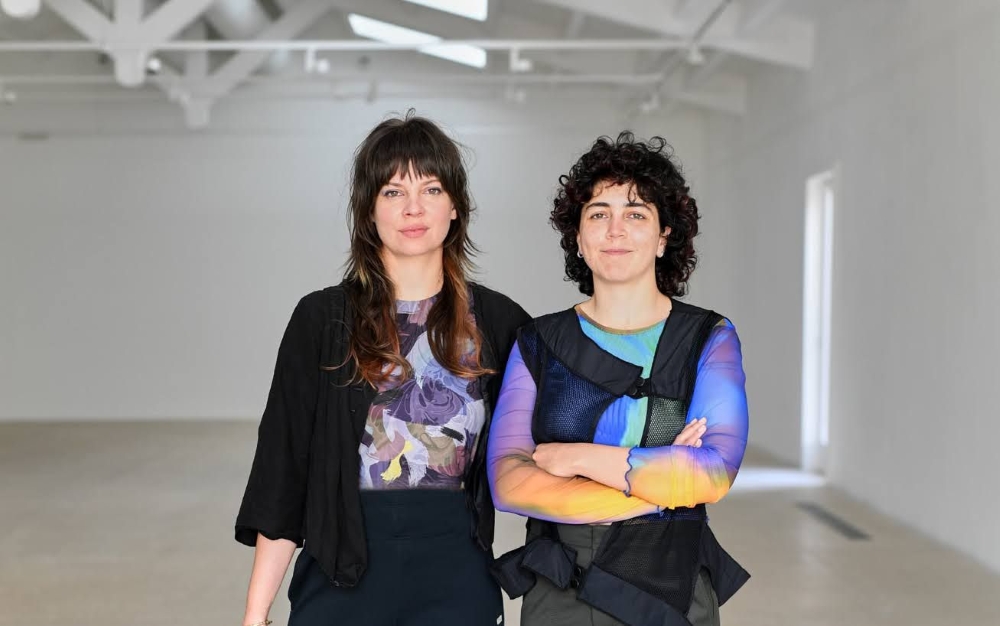
This artist duo were residents of cohort 1, 2025-26.
HUNITI GOLDOX, the collaborative practice of Areej Huniti and Eliza Goldox, explores how political systems and histories of violence shape landscapes and bodies of water. Comprising film, VR, installation and performance, their projects have been exhibited at institutions such as Hauser & Wirth Menorca, the Institute for Postnatural Studies (Madrid) and Darat al Funun (Amman).
During the Sharjah Art Foundation residency, we researched mangroves as a living counter-infrastructure through which to rethink contemporary AI systems, relationality and conditions of collective endurance while developing an immersive installation grounded in these environments. Beginning from the mangrove ecosystems of Abu Dhabi and Kalba City, the project considered how these ecologies metabolise instability rather than resist it: filtering salt, distributing load, sustaining porous boundaries and thriving through interdependence within harsh and shifting terrains shaped by tides, salinity and constant transformation.
Through artistic field research conducted within the mangroves, we engaged in field recording, filming, underwater imaging, sensual documentation and 3D-scanning of root systems and coastal formations, collecting material that later informed the projected environments, sound composition and sculptural elements of the installation. We also experimented with fabric processes, liquid absorption, mapping techniques and CNC-cut forms to translate ecological processes such as filtration, sedimentation and tidal movement into spatial and material gestures.
The resulting installation combined suspended projections, reflective surfaces, textiles, sculptural seating and layered soundscapes to create an immersive environment that invited visitors into a shifting ecology of relation. Hanging fabric strips carried fragments of conversations with AI chatbots around desire and care; over time, turmeric-coloured liquid slowly dissolved the text, foregrounding impermanence, absorption and transformation.
Against this ecological context, the research reflects on contemporary computational infrastructures that increasingly mediate intimacy, attachment, communication and social behaviour. While AI systems frequently borrow the language of life through neural networks, adaptive learning and emergent patterning, their dominant architectures continue to centralise authority, optimise behaviour and convert relations into extractable value. The work questions what it means to imagine systems that do not aspire to mastery or prediction but instead remain in negotiation, filtering rather than absorbing, distributing rather than commanding, and sustaining relations under conditions of instability.
The project was later presented as an immersive installation and activation at the Sonic Acts Biennale in Amsterdam.
Photo by Daniel Schäfer. Image courtesy of Hauser & Wirth Menorca.
 OFF
OFF