Image courtesy of Afraa Ahmed.
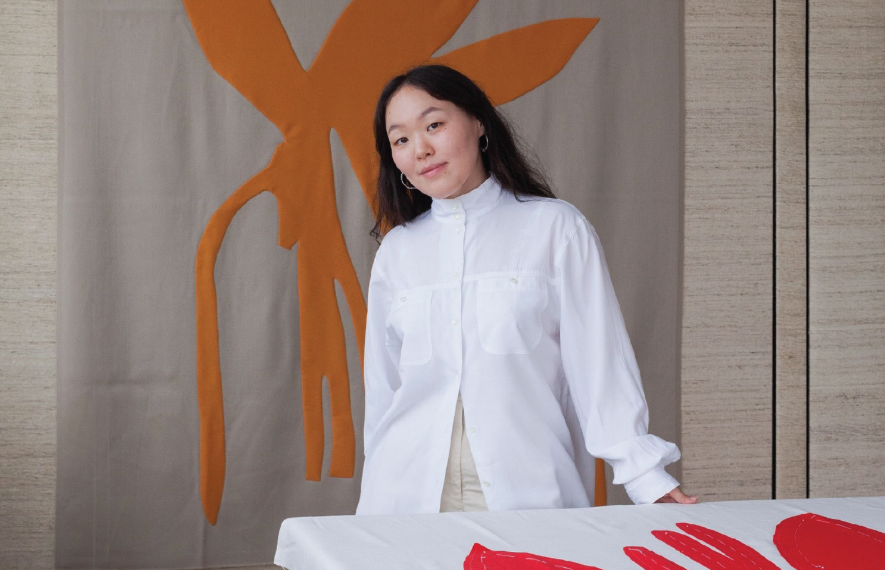
This artist was a resident of cohort 1, 2025-26.
Mila Balzhieva, an interdisciplinary artist from Buryatia, Russia, takes a closer look at multispecies conviviality, ecological grief and ritual through textiles, plants, digital media and drawing. Her work has been presented at institutions including CERN, Geneva; the Venice Biennale; and Vienna Design Week. Balzhieva is the recipient of the Kunsthalle Wien Prize (2023) and BMKÖS AI in Art grant (2025).
During my time at Kalba Ice Factory, I developed a series of large-scale textile works surveying how landscapes leave traces with time and how ecological processes shape matter beyond direct artistic control. As I worked with iron oxidation, plant matter, mud, microorganisms, animals and tides, the residency became a space for exchanges between living systems.
One strand of the research focused on natural processes as forms of inscription. Rust from local boat trolleys and henna leaves stained the textiles over weeks through oxidation and microbial activity, creating textures resembling geological formations and sedimented landscapes.
I developed a second body of work in the Khor Kalba mangroves through burial, tidal exposure and contact with the living systems of the mangrove mud. Once unearthed, the textile revealed ruptures shaped by crab movement and microbial activity, functioning as a material encounter with invisible ecologies and non-human activity.
The residency served as a space to reflect on how acts of creation are never fully autonomous but are instead shaped through continuous contact with diverse forms of life, material conditions and environmental forces. My works operate as recording surfaces where ecological processes become embedded into the material over time. Through this process, the landscape moves beyond being a background, entering the work as a force of transformation.
Image courtesy of Afraa Ahmed.
 OFF
OFF