Photo by Asareh Ebrahimpour. Image courtesy of Richi Bhatia.
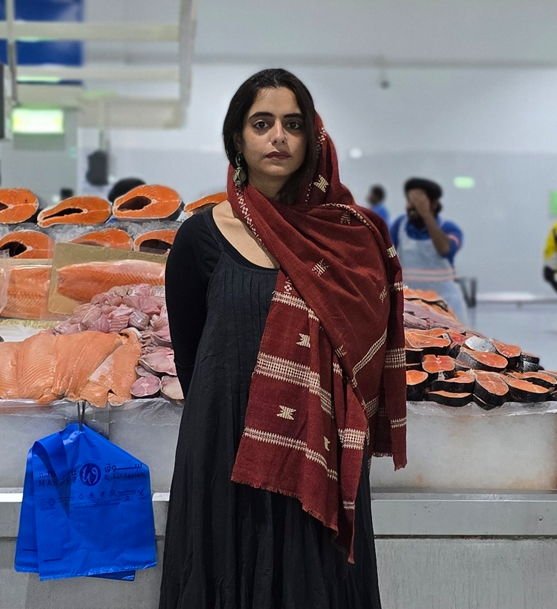
This artist was a resident of cohort 2, 2025-26.
Richi Bhatia is a UAE-based multidisciplinary artist whose practice spans drawing, performance, object-making, assemblage and food intervention. Rooted in embodied research and long, labour-intensive processes, her work explores the body as a sensing tool navigating memory, illness, environment, labour, social systems and the market. Blending the private with the public and the human with the nonhuman through performance and ethnographic inquiry, Bhatia invites audiences into encounters that challenge normative categories and passive spectatorship. Her works and performances have been featured at Foundry, Gallery Isabelle, and Al Serkal Foundation in Dubai, as well as at New York University Abu Dhabi and Bikaner House (New Delhi), among others. Apart from her own artistic research practice, Bhatia has also worked as a curator.
In my residency at Sharjah Art Foundation, I delved deeper into my preoccupation with the interface between meat and fish markets in India and the UAE. As part of my anthropological and ethnographic research, I was able to connect with fishermen from India and Bangladesh along the Sharjah corniche.
During my walks outside the new Jubail Market, I discovered that most fishermen are from Gujarat. Our shared connections led to immediate trust and friendship between myself and a fisherman named Bipin Bhai, who has been fishing for around three decades between Dubai, Sharjah and Umm Al Quwain. With his help, I spoke to other fishermen, learning about their work processes, including preparation of the boat before an excursion, required documents, the economics of their catches and their role in the fish market. I was also given access to the interiors and lower decks of their boats and came to understand how these spaces serve as the fishermen’s home while they are working. Through our conversations, I learned of the hierarchies and rules within their ways of working. It was enlightening to know how cosmopolitan they were and how well they knew the sea and the larger ocean. Some of them had travelled to Iran, Bahrain and Oman to catch and sell fish. It was intriguing to see the relationship of the fishermen to the city, their boat, the corniche (which they use as a backyard) and the water.
I also visited the Kalba Slaughterhouse, where I documented the protocols and procedures followed. I later spent time in a decommissioned slaughterhouse in Sharjah, archiving the residue and afterlife of the premises, in both tangible and intangible ways.
The residency enabled me to transfer my inquiries into ceramic works. I printed imagery I had gathered onto ceramic plates using the silkscreen technique. Apart from this, I continued replicating fine dining meals in ceramic setups using textual, mythological, environmental, political and real-time references.
Beyond the works mentioned above, I continued with my series of drawings ‘Suitcase Lineages: Parallel Movements, Isolations and Dispatches’, a project that attempts to collate dispersed archives of nation-state geography through a matrilineal perspective.
Photo by Asareh Ebrahimpour. Image courtesy of Richi Bhatia.
 OFF
OFF