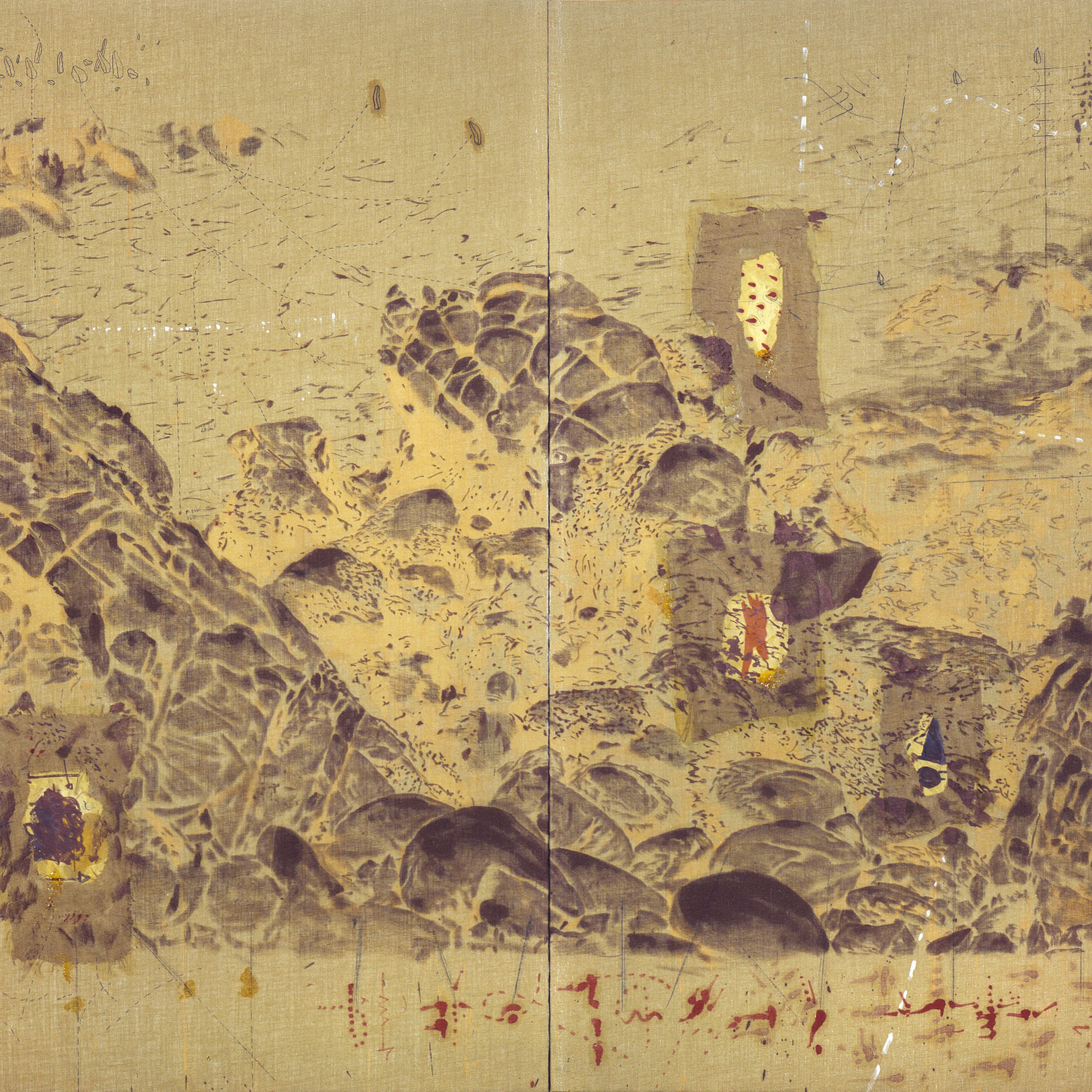
Jorge Tacla, Tiempo y Espacio en Negativo (Time and Space in Negative), 1990. From ‘Un Problema Hemisférico / Tiempo y Espacio en Negativo (Hemispheric Problem /Time and Space in Negative)’, 1989–1990.
Image courtesy of the artist
Published on 5 February 2026
Titled after a line from a T.S. Eliot poem, Jorge Tacla: Time the destroyer is time the preserver examines how enduring truths can be excavated in the aftermath of destruction. Structured as eight chapters, the exhibition brings together over 170 works including paintings, drawings and a large-scale installation and will be on view from 8 February to 7 June 2026 at Galleries 1, 2 and 3 in Al Mureijah Square, Sharjah City.
A third-generation Chilean of Palestinian and Syrian descent, Tacla has been working between Santiago and New York since 1981. The exhibition opens with the chapter titled 'Body and Violence’, which features the artist’s early figurative works from the 1980s, when the artist was immersed in the Black and Hispanic cultural spheres of New York’s East Village. Drawing on Francis Bacon’s depictions of bodies in agony, works such as Untitled (1985) and Diciembre (December) (1988) were produced amid escalating racial tensions and the emergence of the 24/7 news cycle.
This chapter also introduces works from ‘Cuaresma en Atacama / Out of Focus’ (1989), developed after the artist’s time in Chile’s Atacama Desert. This landscape is explored more in the second chapter titled 'Remembering the Desert’ with paintings such as Logical Product #2 (1992) and Paraíso (Paradise) (1994). Within these works, the inclusion of what the artist calls ’remnants of the living’ disrupts the colonialist notion of desert expanses as ‘empty’.
From here, the exhibition turns to architecture as a recurring motif through which Tacla tracks forms of hegemony and resistance. In the third chapter called 'A Geopolitical Triangle’, Distribución de los Primarios (The Distribution of the Primes) (1995) provides an aerial view of the Pentagon, while Ciclo de Nitrógeno (Nitrogen Cycle) (1996) isolates the bombing of Santiago’s La Moneda Palace during the 1973 US-backed coup against Salvador Allende.
The fourth chapter titled 'Injury Report’ addresses censorship and ideological suppression under Chile’s military dictatorship. The section is comprised of a multimedia installation titled Informe de Lesiones (Injury Report) (2016–2019), composed of framed remnants of burned documents, including hospital and police injury reports. The artist has also set fire to some of his own notebook drawings in a symbolic gesture expressing affinity with poets, writers and artists who had been silenced in Chile and beyond.
Gallery 2 is dedicated to Tacla’s notebook drawings, which form the focus of the fifth chapter called 'Anatomy of Dyslexia’. Produced daily since 2011 as part of a morning ritual, these works provided the source material for ‘Anatomía de la Dislexia (Anatomy of Dyslexia)’ (2017–2021), a series of portraits of cultural figures such as theorist Roland Barthes, writer Diamela Eltit and poet Juan Luis Martínez.
The sixth chapter, titled 'Scenes of Protest’, shifts toward collective resistance and mass protest through works from the artist’s long-running series 'Señal de Abandono (Sign of Abandonment)’ (1999–ongoing). In producing Octubre 25, 2019 No. 4 and No. 5 (both 2022), which depict Chile’s 2019 uprising, or May 25, 2020 (2020), a response to the death of George Floyd, Tacla focuses on moments of resistance rather than graphic imagery of violence.
Pushing back against a growing 'compassion fatigue’, the seventh chapter, called ‘Hidden Identities’, surveys works from Identidades Ocultas (Hidden Identities) (2005–ongoing). In these paintings, Tacla depicts violence by proxy, substituting human bodies with architecture, furniture and farming equipment. For example, Identidad Oculta 148 (2019) uses the image of a tractor to references the killing of Mapuche activist Camilo Catrillanca, while in Identidad Oculta 58 (2014), a disorienting coastal view recalls the ‘death flights’ of the Pinochet regime.
The exhibition concludes with a visual field of modern catastrophes that dislodges viewers from fixed positions of moral certainty. In the last chapter titled 'Rubble’, Tacla juxtaposes the aftermaths of political conflict and natural disaster across Aleppo, Beirut, Gaza, Homs, Oklahoma City and Santiago, alongside the devastation from earthquakes in Haiti and Japan. These works are punctuated with compositions that suggest a microscopic analysis of trauma within the human body.
Jorge Tacla: Time the destroyer is time the preserver is curated by Her Highness Sheikha Hoor Al Qasimi, President and Director of Sharjah Art Foundation, with Abdulla Aljanahi, Curatorial Assistant at the Foundation.
Free and open to the public. To book your tickets, visit sharjahart.org
Jorge Tacla is a Chilean-born artist who lives and works between New York and Santiago. Much of his work surveys spaces of social rupture, situated in the joints of the architectures that arise in the wake of catastrophe. He perceives the devastation resulting from such events as an opportunity to investigate structural systems that would otherwise remain unseen. Tacla studied at the Escuela de Bellas Artes, Universidad de Chile, Santiago, and moved to New York in 1981. Since that time, his paintings have been exhibited internationally in galleries, museums and biennials. He has also produced several permanent installations, including murals for a museum in Santiago and a civil court in New York. In 2019, the Smithsonian's Archives of American Art acquired his papers, including Tacla’s drawings, correspondence, photographs, notebooks and clippings. Spanning nearly 40 years, these holdings provide a look into the fluctuating histories of the New York and Santiago art worlds.
Sharjah Art Foundation is an advocate, catalyst and producer of contemporary art within the Emirate of Sharjah and the surrounding region, in dialogue with the international arts community. The Foundation advances an experimental and wide-ranging programmatic model that supports the production and presentation of contemporary art, preserves and celebrates the distinct culture of the region and encourages a shared understanding of the transformational role of art. The Foundation’s core initiatives include the long-running Sharjah Biennial, featuring contemporary artists from around the world; the annual March Meeting, a convening of international arts professionals and artists; grants and residencies for artists, curators and cultural producers; ambitious and experimental commissions and a range of travelling exhibitions and scholarly publications.
Established in 2009 to expand programmes beyond the Sharjah Biennial, which launched in 1993, the Foundation is a critical resource for artists and cultural organisations in the Gulf and a conduit for local, regional and international developments in contemporary art. The Foundation’s deep commitment to developing and sustaining the cultural life and heritage of Sharjah is reflected through year-round exhibitions, performances, screenings and educational programmes in the city of Sharjah and across the Emirate, often hosted in historic buildings that have been repurposed as cultural and community centres. A growing collection reflects the Foundation’s support of contemporary artists in the realisation of new work and its recognition of the contributions made by pioneering modern artists from the region and around the world.
Sharjah Art Foundation is a legally independent public body established by Emiri Decree and supported by government funding, grants from national and international nonprofits and cultural organisations, corporate sponsors and individual patrons. Hoor Al Qasimi serves as President and Director. All exhibitions are free and open to the public.
Sharjah is the third largest of the seven United Arab Emirates, and the only one bridging the Arabian Gulf and the Gulf of Oman. Reflecting the deep commitment to the arts, architectural preservation and cultural education embraced by its ruler, Sheikh Dr Sultan bin Mohammad Al Qasimi, Sharjah is home to more than 20 museums and has long been known as the cultural hub of the United Arab Emirates. It was named UNESCO's Arab Capital of Culture for 1998 and the UNESCO World Book Capital for 2019.
Alyazeyah Al Marri
alyazeyah@sharjahart.org
+971 (0)6 5444113
Jorge Tacla, Tiempo y Espacio en Negativo (Time and Space in Negative), 1990. From ‘Un Problema Hemisférico / Tiempo y Espacio en Negativo (Hemispheric Problem /Time and Space in Negative)’, 1989–1990.
Image courtesy of the artist
 OFF
OFF