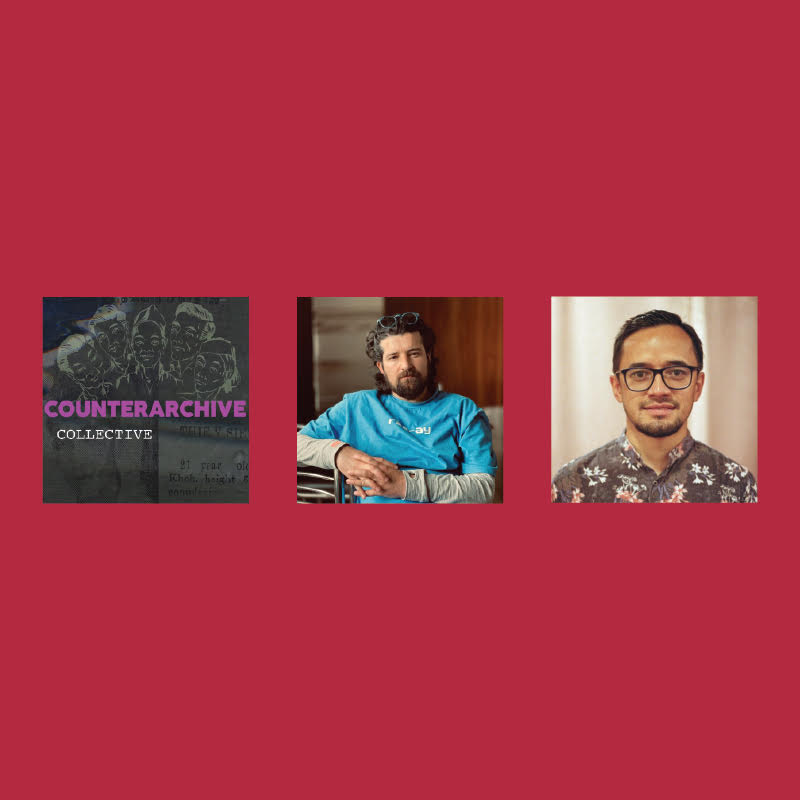
From left: CounterArchive Collective, Nadeem Alkarimi and Rajan Kathet
Three international filmmakers and collectives receive support to develop new short films exploring memory, identity and sociopolitical realities
Published on 7 April 2026
Sharjah Art Foundation is pleased to announce the recipients of the Sharjah Film Platform 8 (SFP8) Short Film Production Grant: CounterArchive Collective for We Return in Pieces, Rajan Kathet for Oxygen and Nadeem Alkarimi for Mila in The Mountains. Engaging critically with histories and lived realities across diverse geographies, their works examine the intersections of memory, resistance, identity and place through distinct cinematic languages.
The selected projects will be supported through the development and production of their films, which will premiere at a future edition of Sharjah Film Platform (SFP), the Foundation’s annual festival celebrating independent cinema and moving image.
Offered in conjunction with SFP, the grant supports the completion of short films that push the boundaries of contemporary filmmaking. The Short Film Production Grant is open to all independent filmmakers through an open call no restrictions on age, region or genre.
CounterArchive Collective is a loose and evolving group of artists, filmmakers and researchers formed in Kuala Lumpur in 2024 through its inaugural Collective Filmmaking Lab. The collective brings together Ali Alasri, Anthony Ngoya, Ben Yau, Chen Yih Wen, Dahong Hongxuan Wang, Eddie Wong, Jakob van Klang, Joshua Kok, Julien Chen, Kevin Bathman Xu Jen, Yao Sau Bin and Yvonne Tan. Artist-filmmakers Michelle Williams-Gamaker and Sabine Groenewegen serve as mentors and supervising directors, while curator Jo-Lene Ong acts as research advisor and producer.
Their film, We Return in Pieces, emerges from research into documents held in the UK National Archives relating to the Malayan Emergency (1948–1960). It adopts speculative reconstruction, collective authorship and performative research as methods. The resulting omnibus short film reimagines a Cold War-era conflict between the Malayan independence movement and the British Empire. Foregrounding filmmaking as a tool of resistance, remembrance and repair, We Return in Pieces constructs counter-narratives to colonial histories. Through a series of vignettes, it stages imagined conversations, speculative reenactments and encounters with archival absences.
Kathmandu-based filmmaker Rajan Kathet works across fiction and documentary. A graduate of the European Masters DocNomads, he is a Berlinale Talents alumnus and Global Media Makers Fellow. His films have been presented at festivals, including Lima, Mumbai, Seattle, Sheffield, Tampere and Toronto. His previous film, No Winter Holidays (2023), co-directed with Sunir Pandey, received multiple international awards, including the NATIVA Award at the Alternativa Film Awards.
Kathet’s Oxygen follows Abhilekh and his retired father as they attempt to return a malfunctioning oxygen concentrator needed for his mother’s severe asthma. What begins as a simple errand gradually reveals tensions between them. Through an intimate narrative, the film offers a subtle yet powerful exploration of generational conflict, love and struggle—both emotional and physical—in a world that often feels suffocating. Oxygen is a story of the longing for space to breathe, to speak and to simply be.
Nadeem Alkarimi, an Indigenous filmmaker and multidisciplinary artist from Gilgit-Baltistan's Hunza Valley, captures the fragile interplay between humanity, tradition and a rapidly changing world. Merging narrative storytelling with documentary realism, his works shed light on marginalised voices and vanishing ways of life. His films have been recognised internationally, including awards at the International Arab Film Festival Alnajh and the Karachi Biennale. He is also co-founder of Circus Cinema, the first fiction film collective in Hunza.
Alkarimi's Mila in the Mountains unfolds in the Hunza Valley, where a young man named Noman forms a bond with a husky named Mila amid rising social tensions. Beneath the region’s natural beauty, the film reveals systemic failures, including environmental neglect and institutional injustice. Following Mila’s death, the narrative becomes a reflection on accountability, grief and the limits of justice.
Sharjah Film Platform (SFP) is an annual festival of independent cinema and experimental filmmaking where audiences can discover new approaches to film and art. The 10-day event, including a range of regional and international films, talks by filmmakers and industry professionals, workshops and gatherings, is centred around Mirage City Cinema, the open-air theatre in Sharjah’s historical quarter. Organised by Sharjah Art Foundation, SFP foregrounds recent cinematic achievements by international filmmakers and artists, noteworthy classics from around the region as well as experimental films that challenge the idea of what film practice is today.
Sharjah Art Foundation is an advocate, catalyst and producer of contemporary art within the Emirate of Sharjah and the surrounding region, in dialogue with the international arts community. The Foundation advances an experimental and wide-ranging programmatic model that supports the production and presentation of contemporary art, preserves and celebrates the distinct culture of the region and encourages a shared understanding of the transformational role of art. The Foundation’s core initiatives include the long-running Sharjah Biennial, featuring contemporary artists from around the world; the annual March Meeting, a convening of international arts professionals and artists; grants and residencies for artists, curators and cultural producers; ambitious and experimental commissions and a range of travelling exhibitions and scholarly publications.
Established in 2009 to expand programs beyond the Sharjah Biennial, which launched in 1993, the Foundation is a critical resource for artists and cultural organizations in the Gulf and a conduit for local, regional and international developments in contemporary art. The Foundation’s deep commitment to developing and sustaining the cultural life and heritage of Sharjah is reflected through year-round exhibitions, performances, screenings and educational programs in the city of Sharjah and across the Emirate, often hosted in historic buildings that have been repurposed as cultural and community centers. A growing collection reflects the Foundation’s support of contemporary artists in the realization of new work and its recognition of the contributions made by pioneering modern artists from the region and around the world.
Sharjah Art Foundation is a legally independent public body established by Emiri Decree and supported by government funding, grants from national and international nonprofits and cultural organizations, corporate sponsors and individual patrons. Hoor Al Qasimi serves as President and Director. All exhibitions are free and open to the public.
Sharjah is the third largest of the seven United Arab Emirates, and the only one bridging the Arabian Gulf and the Gulf of Oman. Reflecting the deep commitment to the arts, architectural preservation and cultural education embraced by its ruler, Sheikh Dr Sultan bin Mohammad Al Qasimi, Sharjah is home to more than 20 museums and has long been known as the cultural hub of the United Arab Emirates. It was named UNESCO's Arab Capital of Culture for 1998 and the UNESCO World Book Capital for 2019.
Alyazeyah Al Marri
alyazeyah@sharjahart.org
+971 (0)6 5444113
From left: CounterArchive Collective, Nadeem Alkarimi and Rajan Kathet
 OFF
OFF