 Image courtesy of the Artist and Fridman Gallery
Artwork Details:
Artist(s)
Dindga McCannon
Title
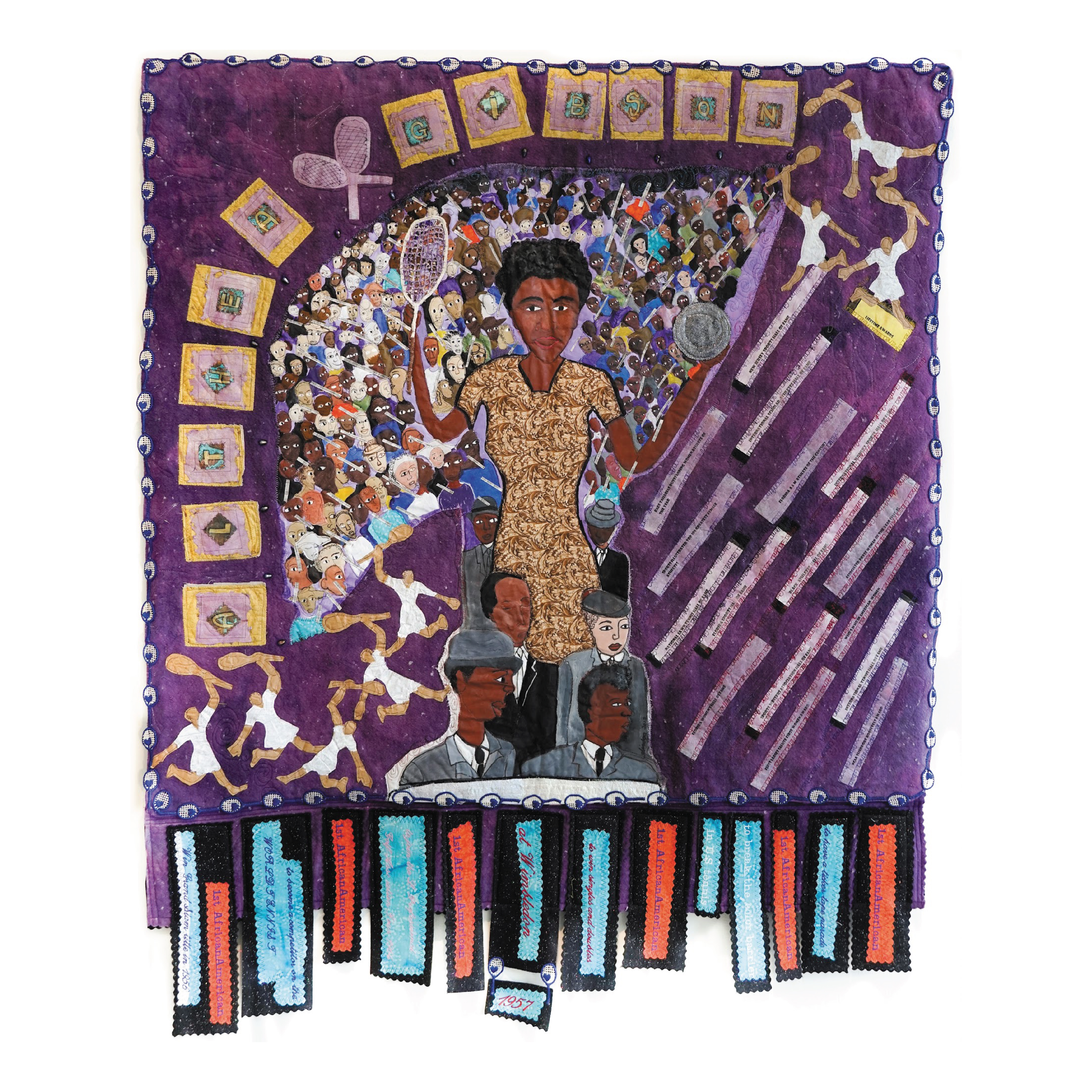
Althea Gibson, First African American to Win Wimbledon 1957
Date
2012
Medium(s)
Mixed media quilt
Dimensions/Duration
231 x 122 cm
Photo Credit
Althea Gibson, First African American to Win Wimbledon 1957
Born in Harlem, New York, in 1947, Dindga McCannon resolved to become an artist at an early age. Deeply informed by craft traditions (particularly the ‘needle arts’ of sewing and embroidery, passed down from her mother and grandmother), McCannon would develop her practice to span from illustration, painting and murals to printmaking and textiles. By the age of 17, she had joined the Weusi Collective, a Harlem-based artist collective that championed the principles of the Black Arts Movement, a broader cultural movement that envisioned, as writer Larry Neal put it, ‘an art that speaks directly to the needs and aspirations of Black America’.
In her 2012 mixed-media quilt Althea Gibson, First African American to Win Wimbledon 1957, McCannon commemorates the life and legacy of an athlete who broke racial barriers in professional tennis and became a global symbol of excellence. Combining sewn textiles with painted and collaged elements, the quilt operates simultaneously as portrait, archive and tribute. At the centre, Althea Gibson lifts up her tennis racket and the ceremonial Venus Rosewater Dish, which was presented to her by Queen Elizabeth II. Behind her, a densely-packed crowd appears to both celebrate and scrutinise Gibson, a reminder that her success unfolded within a society still marked by segregation and inequality.
In 1957, Gibson became the first Black woman to be honoured with a ticker tape parade in New York City. In a nod to this historic event, McCannon uses ticker tape to catalogue the athlete’s various accolades, including the International Women’s Sports Hall of Fame and Associated Press Woman of the Year. She trims the bottom of the quilt with blue and red ribbon-like banners announcing other milestones.
This framing of Gibson’s achievements through ‘firsts’ underscores both their historic significance and the limits of recognition shaped by race and gender. By embedding her portrayal in a material tradition that resists erasure, McCannon situates her protagonist within overlapping systems of visibility, ultimately reclaiming a Black woman’s history as a site of strength, joy and complexity.
