 Shanavas Jamaluddin
 Shanavas Jamaluddin
Artwork Details:
- Artist(s)
- Rayyane Tabet
- Title
- Exquisite Corpse
- Date
- 2017
- Medium(s)
- Military tents, maps, genealogical tree, books, stakes, rope
- Dimensions/Duration
- Dimensions variable
- Photo Credit
Exquisite Corpse
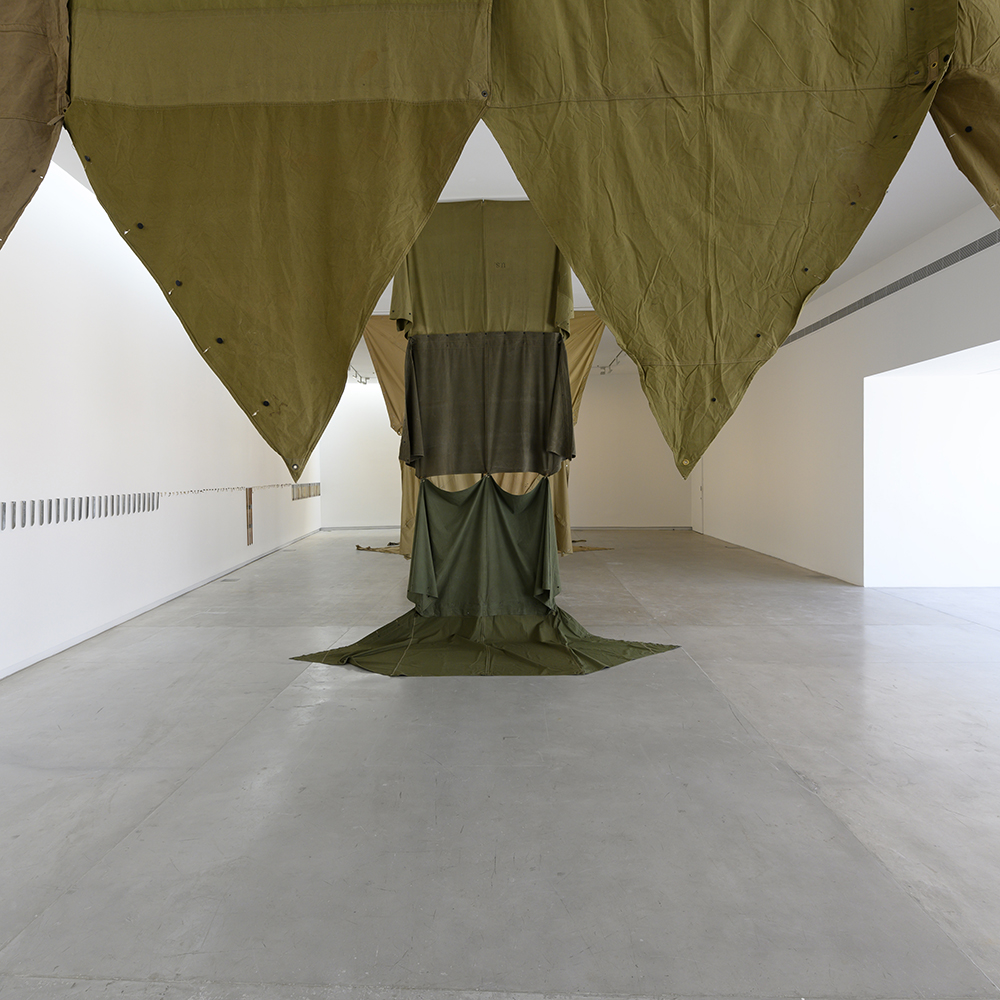
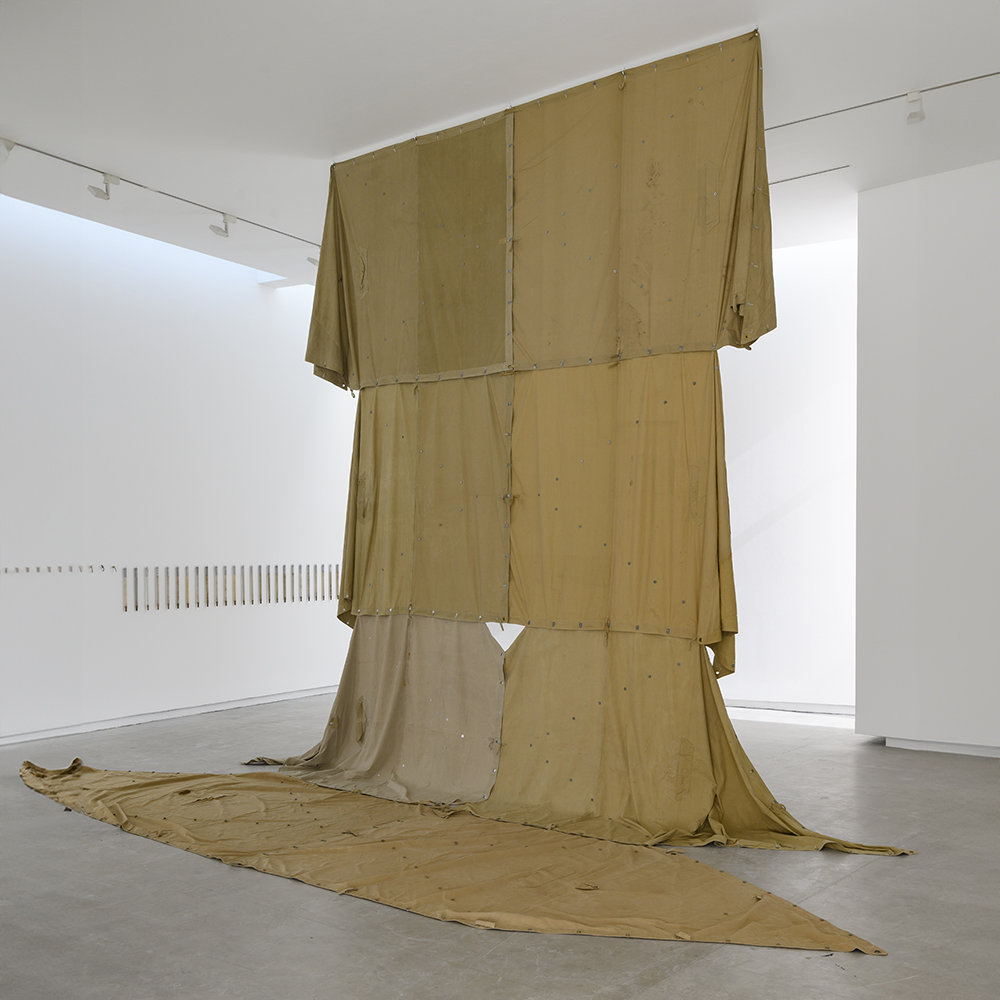
Informed by his training in architecture and sculpture, Rayyane Tabet investigates paradoxes in the built environment and its history. Exquisite Corpse (2017) is an installation composed of several unstructured single-soldier tents. These tents were used by Germany, Russia, France and the United States in military campaigns across North Africa, the Levant, and the Arabian Gulf throughout the twentieth century. Central to the installation is a simple, square-shaped design introduced by the German military in 1899, which bears a striking resemblance to a ‘bisht’, a traditional Bedouin cloak that could be transformed into a provisional shelter when propped up by wooden poles. The other tents in the installation vary in scale and complexity, reflecting a range of military design strategies and histories. In conjunction with the tents, Tabet presents Max von Oppenheim’s four-volume tome on Bedouin tribes, which was published between 1939 and 1968. Containing information sourced from ethnographic work undertaken alongside the Tell Halaf excavation, these books are accompanied by a document charting the family trees of Bedouin tribes as well as maps that outline their summer and winter migrations. Together, these elements consider contrasting ways of inhabiting land and territory: some reflecting the overexploitation of land—with the requirement of constant expansion of territorial borders—and others that are environmentally sensitive to seasonal cycles.