 Photo: Shafeek Nalakath
Artwork Details:
- Artist(s)
- Novera Ahmed
- Title
- Le Serpent Nommé Desir
- Date
- 1972
- Medium(s)
- Bronze
- Dimensions/Duration
- 199 x 47 x 35 cm
- Photo Credit
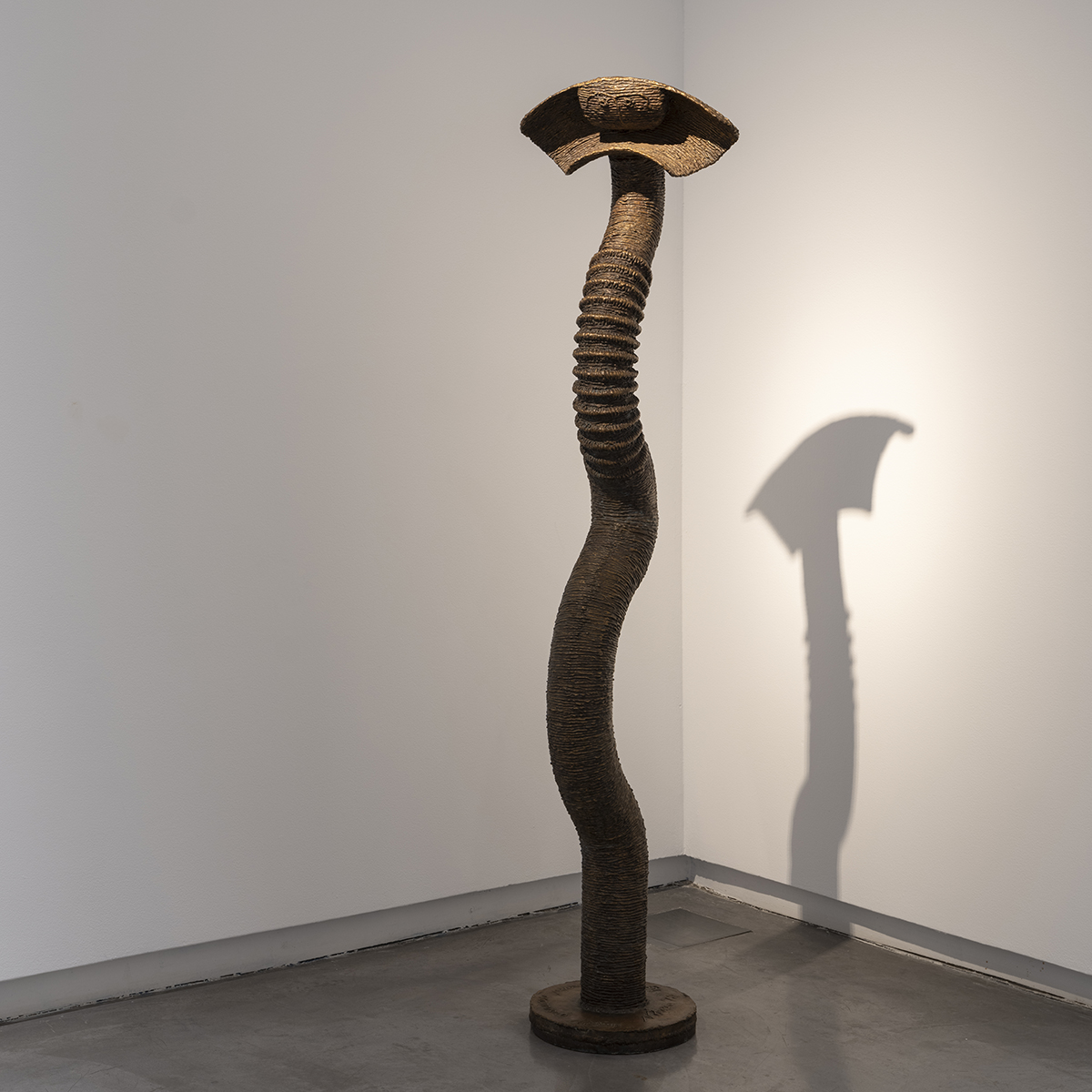
Le Serpent Nommé Desir
Novera Ahmed was a pioneering sculptor whose fascination with three-dimensional forms was ignited by observing her mother crafting dolls and clay houses. Ahmed's life and legacy, extended across the Indian subcontinent, Southeast and East Asia, as well as Europe. Ahmed studied with Jacob Epstein and Karel Vogel in London and was later trained by Venturino Venturi in Florence and Vienna. A key preoccupation for Ahmed involved linking her culturally specific, gendered and ethnic influences with what she was learning in the western world. Aesthetics associated with Indigenous and folk culture, alongside Buddhism are foregrounded in her practice. Her early sculptural works produced in stones and concrete revolved around geometric shapes, as well as anthropomorphic forms that combined human figures with animal features. She later transitioned to using iron, steel and eventually bronze to create sculptures that seemed ‘materialised’, what she argued was her ‘invisible realm’. In Le Serpent Nommé Desir (1972), the sinuous curves and fluid lines of the serpent embody complex desire, while also alluding the sense of myth and enchantment associated with her subject.
