Publication details:
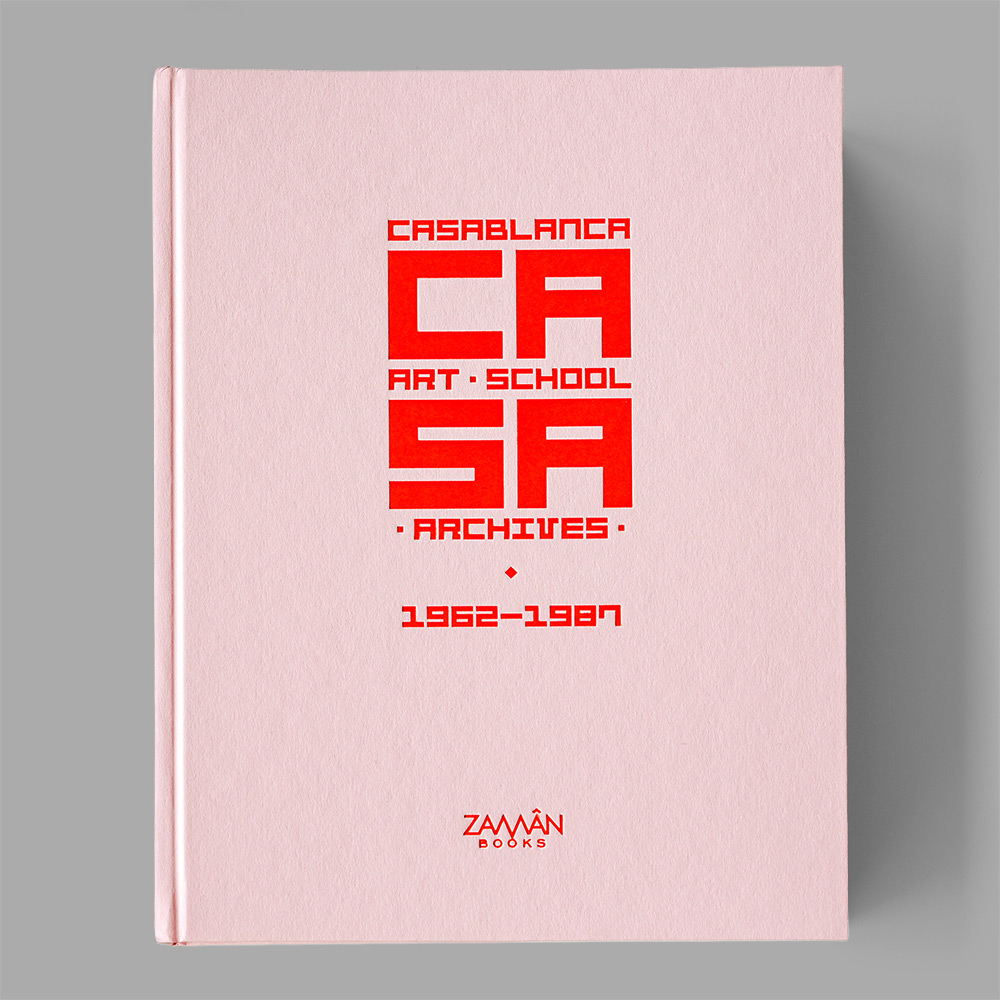
C.A.S.A. – Casablanca Art School Archives 1962 –1987
Essay Collection
Edited by Madeleine de Colnet, Maud Houssais, Fatima-Zahra Lakrissa and Morad Montazami.
Hardcover
493 pages, 580 visuals
22 × 29.5 cm
English
Published by Zamân Books
2026
ISBN: 979-10-93781-00-6
Overview
In the momentum of Morocco’s independence in 1956, the Casablanca Art School (CAS) became the centre of a radical reconsideration of art and its role within society. CAS teachers and students sought to move past colonial constructs of art education, turning to the rich visual legacy of their own land. Beyond formal studios and classrooms, their work extended into streets, public buildings, magazines and exhibitions, making art part of the texture of everyday life.
While the core CAS group (Farid Belkahia, Mohammed Chabâa, Bert Flint, Toni Maraini and Mohamed Melehi) led the first wave of this transformation, CAS’s influence was shaped by a much broader constellation of artists, writers, designers and activists who drew on Moroccan and Afro-Amazigh legacies as they developed new approaches to abstraction and forged connections with cultural and political movements across Africa, the Arab world and beyond. These collaborations gave rise to an expansive practice spanning painting, photography, typography, graphic design, murals and exhibition-making.
Edited by Madeleine de Colnet, Maud Houssais, Fatima-Zahra Lakrissa and Morad Montazami, the anthology reconstructs this vital period through foundational texts, first-hand accounts and a substantial body of never published before archival material, including essays, interviews and documents from the school’s courses, workshops, exhibitions and publications.
Launched in April 2026 with the support of Sharjah Art Foundation, the book builds on research connected to the exhibition The Casablanca Art School: Platforms and Patterns for a Postcolonial Avant-Garde (1962–1987), presented at Al Hamriyah Studios and Old Al Diwan Al Amiri, Sharjah, from 24 February to 16 June 2024. Together, this book and related exhibition illuminate the collective endeavour behind CAS and its enduring significance to postcolonial art history.
