Susan Hefuna uses a variety of media, including drawing, photography, sculpture, installation, film and performance to create multilayered works informed by her dual German Egyptian heritage and personal experiences in life. Awarded the Daniel and Florence Guerlain Contemporary Drawing Prize in Paris in 2013, Hefuna has exhibited widely and internationally, including solo exhibitions at Osthaus Museum, Hagen, Germany (2014); PiArtworks Istanbul/London (2014 and 2011); Rhona Hoffman Gallery, Chicago (2014 and 2012); and Rose Issa Projects London, UK (2013 and 2010).
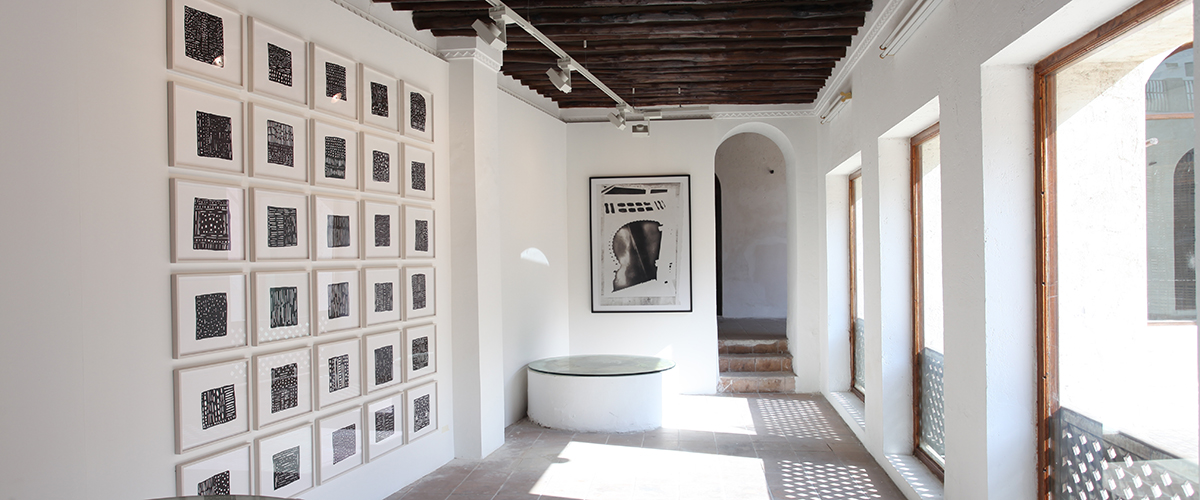
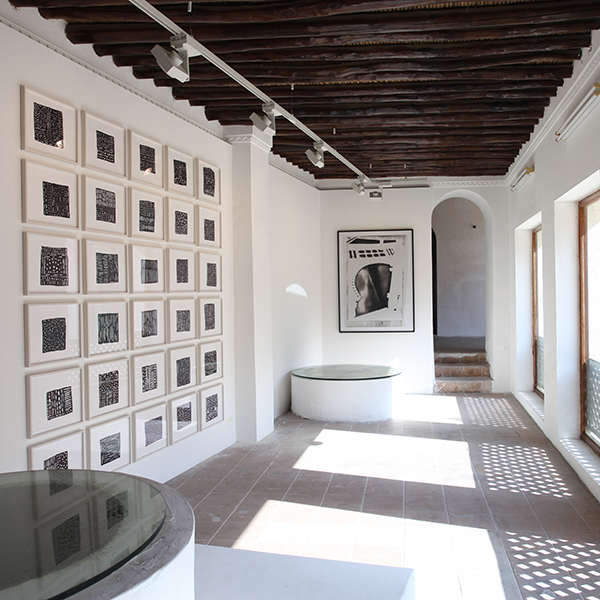
On the occasion of her Sharjah show, Another Place, at Bait Al Serkal, Hefuna speaks to the exhibition curator Hoor Al Qasimi, President and Director of Sharjah Art Foundation. They discuss the artist’s large scale installations based on afaz [traditional palm wood boxes in Egypt], Sharjah Ceilings, a series of 30 drawings made specifically for this exhibition, her Crossroads series of videos and the importance of language.
Excerpts:
Susan Hefuna: It was so great seeing the afaz [cage in Arabic] structures in the courtyard today, the shadows… I think people will understand their connection to my drawings, because like my drawings the structures are not totally straight which makes them more organic.
Hoor Al Qasimi: When was the first time you started working with the afaz?
A long time ago, I think it was 1992 or 1991 for an exhibition in Cairo.
How did you start working with them? What inspired you to use them?
I observe and notice these things when I go to Egypt. I see these structures because I am distant.
How often do you go to Egypt?
Often but I think that’s why I see these structures and they have always fascinated me. I also made a series of photographs, five or six years ago where I took photographs of all the afaz boxes I could find in different cities in Egypt; Alexandria, Damanhour, Tanta, Karf-El-Sheikh, in the Delta, Cairo, etc. They are in the street and people use them as shops and make ‘kushari’ in them and then suddenly it becomes a restaurant. They’re all over the place and they change the arrangements of the afaz on the street everyday; which makes it like organic architecture.
People who see them on the street know that there is a defined place, they’re either selling something or preparing food. The sellers define their own space. It’s very interesting I think how these palm wood structures are still hand made until today when everything has become plastic. Everything is made by hand, stuck together by hand, no nails or glue are used and I like that. When I’ve made these structures before, children started climbing on them. They’re fragile but at the same time strong.
But children couldn’t climb on these, they’re too high.
Right, of course. I haven’t made them this high before, because it was limited to the gallery ceiling. It was a long time ago, around 1990, and when you invited me to see the space in Sharjah and I saw the courtyard I knew I wanted to recreate them here in this way. You can walk in between them or look at them from above. Because my drawings are also like structures that aren’t straight you can see the shadow on the ground and on the walls of the courtyard now. It’s nice to see everything together in one place. Inside you see the drawings then you walk outside or look out the window and see the afaz ‘drawings’. The shadows change throughout the day with the sunlight, it’s different… if you look in the afternoon or in the morning.
It has been interesting seeing how the birds started interacting with them.
Yes, this is amazing how the birds are using it and interacting and coming and going, you can also hear the sound of the birds in the courtyard. The structure is attracting animals and birds.
How about your wooden sculptures? To me they’re quite different from your other sculptures, for example the mashrabiyas.
Yes, but they are connected to my drawings.
Yes, definitely. How many of them have you done?
I don’t know maybe around 15? They are three-dimensional drawings, I draw on them, also always with ink, I made them in 1991.
I only selected three for this exhibition, how did you decide on the shapes of these sculptures?
Like a drawing—I just start at one point and draw a shape. You said they remind you of the building, it is very architectural and from above it does looks like a building.
It reminded me of the plan of Bait Al Serkal as we were working on the exhibition.
Yes! But also when you look at the drawings on there they are also very three-dimensional. After I made these I started making drawings using tracing paper. So in 1990 or 1991 I did these and in 1992 I did my first drawing on tracing paper. Using several layers, one layer for me wasn’t enough.
Are they linked to the idea of the mashrabiya or the afaz?
No, I don’t think so, but people often think they are. When I do my work I don’t think about the way they are connected, maybe they are and I realise it afterwards but I don’t intentionally try to link them to one another.
Then you wanted to add layers to them?
Yes, because for me, the drawings were too flat, so I wanted to have more layers to make them more three-dimensional. Like viewing the afaz structures in the courtyard from the roof, looking down at the them from a bird’s eye view.
It gives the drawing more depth and volume while remaining a drawing. What do the letters in your series of drawings ‘Building’ represent?
It’s like a poem, but very abstract. You can sometimes read the letters together but it’s not written on one line.
You use a lot of text in your work, we’re not showing many of your other work with text but how important is language to you?
It’s important because of life experiences, there are often many mistakes or misunderstandings in language. I was growing up between two different cultures and I experienced this at times where people who speak the same language can also miscommunicate. Like German, for example, my father came from Egypt, and spoke German but when he would say things sometimes the meaning of the phrase would be very different from what he was trying to say.
Like a literal translation?
Yes, for example in the mashrabiyas I use words in a way you can read them from a distance but not as clear closer up then they become totally abstract. I often play with words.
Like your work Ana, how did that project start?
In 2004–2006, I was always in Cairo and working at the university. I’m often inspired by things I have experienced in life at the time. I could feel how people in society were behaving, they couldn’t or wouldn’t give any statements, everybody referred to someone else’s response or opinions. Nobody took responsibility for anything by giving their own opinions even for small things, I felt that people should at least say the smallest statement, of course in the west everyone says me me me, but in this context I felt that everyone wants the whole community and not just themselves to decide on things, for example saying I think this should be this colour… So I went to the streets and asked people to say the word ‘ana’ [me in Arabic], this was in 2006.
What was the response from the people?
They were shy at first, a lot of them didn't want to do it. I asked people from different backgrounds and generations in various neighbourhoods in Cairo, when older people say ‘ana’ they feel connected to it and with a lot of life experience.
Do you think older people have more confidence?
Yes, I felt that very much you can see it in their faces and how they said it. I like the Arabic word ‘ana’, in the video you see me saying ‘Ich’ (German), and ‘Ich’ sounds very harsh and ‘ana’ sounds like a smooth beautiful and flowing word. It’s not me, me, me in an egoistic sense, I think people have to find their inner self first.
Do you think people also don’t want to offend and therefore don't state their opinions?
I think they were afraid of thinking and censored their thoughts and if you censor your thoughts you can’t have fantasies. I was thinking of fantasies when I worked on the Vitrines of Afaf project.
Can you tell us some of the stories and about your interaction with the people?
I often start at one point with projects not knowing where it would end up. Like with my drawings where I start somewhere with a line or a dot, without having the final image in mind of what the drawing will or should look like. I know I want to start somewhere. In 2007, I was invited by William Wells at Townhouse [Gallery in downtown Cairo] to show again. I had shown there many times before and have known the Townhouse from the very beginning when it first opened.
I had the idea that I wanted to do something, like a workshop and work with all the women who are related to the workers who hang and install at Townhouse, but I had never met them before. I decided to meet these women and do a workshop or something like that, but I was told that I had to go to their houses since they don’t really leave the house. So I went to their homes in the suburbs, over a two-hour drive and it became a three-month project, so I got to know them pretty well.
You spoke about the plate that kept disappearing.
Yes, one woman lived in a room with her whole family. The kitchen, bedroom and everything was in one room, I asked her to give me something that was important to her and she knew that this object would go in a vitrine and this vitrine would travel around the world. She gave me a plate and I asked why this plate and she told me the story about how this plate kept disappearing but appearing again, like magic, but it just looked like an ordinary plate. It’s interesting because when I went to Japan later, I was told that all objects have a life.
I did some similar work in Cape Town in 2001. It was amazing how seriously people took it there—in the end it became like a shrine. It was also an afaz shipped from Egypt, an empty gift to the people of Cape Town, which they then filled with objects. I came up with this idea when I had spent three months at Cape Town and met many people from different communities who never mixed together. I wanted them to bring things into this structure, things that aren’t related to any specific group but are personal to them. They brought herbs and spiritual stones and in the end they came to the opening. A lot of these people wouldn’t normally enter the museum space.
Then what happened to the shrine and how did people react to it?
It was reviewed as a very political work.
Was this because you brought different parts of society together?
Yes. Of course it always depends where things are done and in which context. People project their own reflection on the work. In this context it was very political, even if it was simple.
Can we talk about your videos and Crossroads series?
I started the Heartbeat video, which is very old, in 1990 and at that time my work was more technical. I studied with Peter Weibel then at the Institute for New Media in Frankfurt. I think I showed the piece in 1992 in Cairo.
Have you done other videos like that since?
I did some videos like that during that time, but then in 2000 I started to do these crossroads videos without a lot of editing. I edit before the actual shooting in my mind, I choose the right angle, what I want to film, I spend time watching locations before and then I film it without interfering. I started with Life in the Delta filming through a window from our family house where I spent a lot of time as a child, people coming to the cotton and rice fields and it was exactly the same scene as it was in the past. I know it very well, there is a lot going on even though at the same time nothing is happening.
Then I did Cairo crossroads, through townhouse windows, always using places I’m connected to. This is the first time I see all my crossroads videos together in one exhibition.
Then you did Edgware Road, part of the Edgware Road project.
Yes, and it looks great in this space, I made it for the Serpentine in connection with Townhouse and Edgware Road. There are different spots on the Edgware Road and sometimes you see me in the films sitting in a café or somewhere. When I showed them in Cairo they were shown on TV monitors in cafes and on the streets, people thought it was somewhere in Cairo because of the Arabic street signs. Then there is one I filmed in Frankfurt, Via Fenestra, Frankfurt/Oder, where I was invited to show in a show called Via Fenestra, it was later supposed to be exhibited in a church. It’s not Frankfurt am Main, it’s the Frankfurt on the border of Poland and at the time, 2002 was very right wing. I heard about a Jordanian man who wanted to go to the other Frankfurt and took the wrong train, ended up in this place and was beaten up by right wing extremists.
I sat on a chair in front of this church and was filming from another window. In Egypt, if you sit on a chair on the street it’s normal but in Germany, especially in this place it was strange, I was sitting there like a sculpture.
Were you intimidated?
I was very tense, I didn’t talk to anyone, I was just sitting there. First people tried to avoid me but they made it obvious or insinuated that I was in the way. Then some people walked towards me and asked me what religion I practiced. I never answered them. I was like a sculpture. They asked why I was sitting there and if I was a gypsy, then more and more people crowded around to talk to me.
It’s similar to my work with language, people project things on to you and it’s different depending where you are. It has to do with the people and not with yourself. A small thing like sitting on a chair can make it visible, depending on the context.
Is that the only time you did that performance?
Yes, the idea came to me because of the situation that happened in that specific location and atmosphere.
Did people get angry and frustrated when you didn’t answer.
Yes, I never spoke to them and after a while they left. Nobody did anything to me, they just left.
And now you’re filming a crossroads in Sharjah from Bait Al Serkal.
I have been watching the people in the market from the window and a lot seems to be happening.
You also worked on Sharjah Ceilings [a series of 30 ink on paper drawings], specifically for this exhibition.
I had visited the house many times before and when I knew I was going to exhibit here I wanted to capture the atmosphere but I didn’t know what I was going to do exactly. Then when I was here last year I spent more time in the house thinking about the exhibition, I went back to New York and worked on them there. I remembered how the light goes through the small cracks in this old house. The ceilings are made from wood but you still feel like there is light coming from them somehow.
Your photographs and the family series have a certain blurry quality to them.
My family is in the Nile Delta and it’s a very different life than from Cairo. I like the photos to be abstract and I used a pin hole camera. Now people avoid dirt and dust when they develop films but I did the opposite, I developed it on the street and used old liquid because I wanted to include life in the process. I photographed them again and again so you see the layers; I photographed the photographs.
Like drawing on tracing paper.
Yes, so it becomes abstract even though it comes from reality.
And your use of the mashrabiya is seen in many of your works.
I was inspired very much since childhood by the old architecture in Cairo and had visited the Gayer-Anderson Museum many times, and in 1997, I took that photo, Woman behind Mashrabiya, in that house. There is a story about the spirit of a woman who lived in that house, they say her ghost still lives in the house.
The photographs for 4 women, 4 views were also taken in the Anderson house, correct?
Yes, this house in Sharjah also has similar architecture, bannisters, terraces and railings. What maybe becomes more apparent to me when I look back at my works here in this exhibition is that it’s all about structure, I work in many mediums: video, drawings, installation, but my work is all about structure, even when I work with people. It’s also about structure but on another level.
Susan Hefuna: Another Place was on view at Bait Al Serkal, Arts Square, Sharjah from 13 March to 13 June 2014.