Published on 24 November 2026
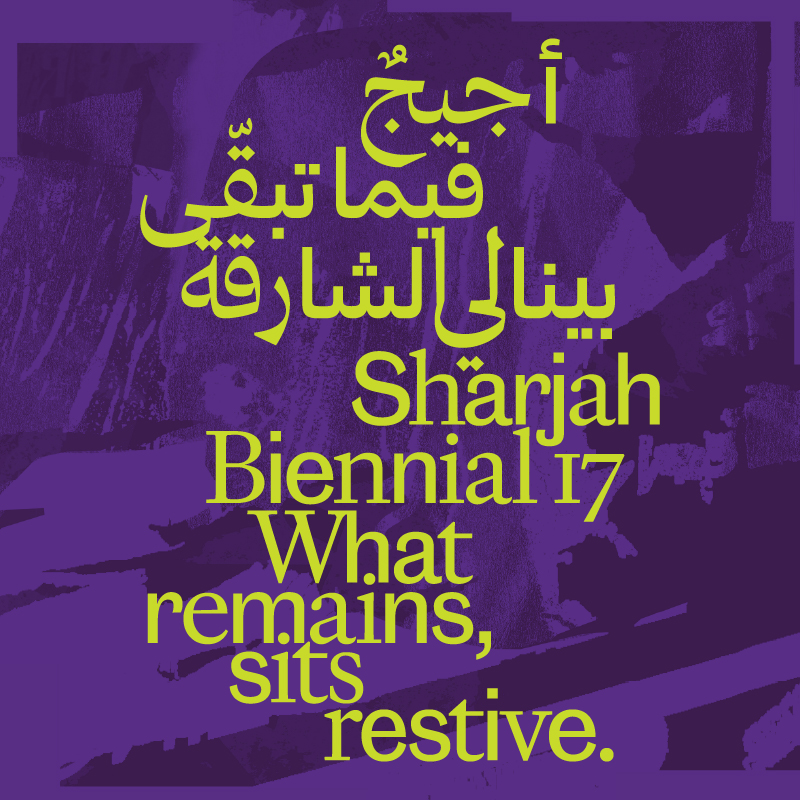
Sharjah Biennial 17: What remains, sits restive
21 January–13 June 2027 | Opening week: 21–24 January 2027
Sharjah City, Al Dhaid, Kalba and Khorfakkan
To register for the opening week programme, click here
Sharjah Art Foundation presents Sharjah Biennial 17: What remains, sits restive from 21 January to 13 June 2027 across 13 venues in the Emirate of Sharjah. The Biennial traces how unresolved histories, colonial legacies and past political ambitions shape the present and explores new possibilities for the future. Addressing this common agenda, curators Angela Harutyunyan and Paula Nascimento interweave queries on the politics of time and space through two distinct approaches.
Dealing with the uneasy heritage of socialist modernity, Harutyunyan attempts to uncover and activate the afterlives of political projects premised on universal emancipation. She seeks to make legible the uneven temporalities that constitute our present, asking how art can give form to contemporary contradictions while still imagining new horizons. Harutyunyan’s presentation, including 32 new commissions, gathers the work of 55 participants from geographies such as Armenia, Georgia, Kosovo and Lebanon. Aiming to historicise the intersection of art and politics today, her project also incorporates four monographic clusters and a special exhibition curated by Natasha Gasparian on the anti-colonial artistic avant-garde in 1960s and 1970s Beirut. To further tackle historical conditions underpinning contemporary art production, an extensive global anthology of art historical documents released in the post-World War II period will be published in collaboration with ARTMargins and Afterall.
Nascimento’s presentation arises from the ways in which the continuous erasing of history, through colonialism and other forms of violence, defines our territories, built environment and spatial politics. From symbolic occupations to the recreation of entire landscapes, colonisation has resulted in spaces that simultaneously embody various articulations of time and the spectral presence of fractured and silenced memories. Rethinking infrastructure as both a concept and a process for communal encounters, Nascimento turns to the alternative artistic structures and vocabularies in the work of 56 participants from geographies such as Angola, Cabo Verde, South Africa, Taiwan and Brazil. Many of the projects, which include 31 new commissions, inquire into the conditions necessary for repair and epistemic justice, often engaging audiences in collaborative processes through the embodied practices of sonic structures and listening as well as interdisciplinary research and non-traditional forms of spatial reconstruction. Nascimento’s presentation also integrates a smaller exhibition of works by six artists, curated by Kiluanji Kia Henda, which investigates how territories marked by the systemic erasure of history can reemerge through fictional narratives and unconventional approaches to archiving.
A crossroads of transcultural encounters, Sharjah is well situated to host a Biennial coalescing around diverse art histories and schools of thought. Across the emirate, the multifaceted venues–from modern white cubes to repurposed institutional structures to traditional houses–spatialise temporal layers informed by the historicity and natural environment of the site. As visitors view the Biennial works, they are invited to take part in this cross-conversation, sometimes in resonance and sometimes in tension, to imagine a generative landscape open to possibility.
Among the highlights of the opening week programme is Ângela Ferreira’s intervention into a 1970s cinema, a site where various postcolonial geographies, histories and aesthetics converge. Ferreira asks what happens when architecture travels. Based on extensive archival research, Cynthia Zaven’s performance revives a lost tradition of women’s sea songs in the Arabian Gulf, some expressing collective grief and others reaffirming the role of the women left behind when the mariners have departed.
Composed of sound-generating sculptures, Christian Salablanca Díaz’s assemblage is rooted in his memories of boat trips with his father through the Sierpe mangroves and wetlands on the Osa Peninsula in Costa Rica. Set in the diverse landscape of Sharjah, Jessica Ekomane’s performance cultivates a kind of ‘sonic fiction’ through her use of purely synthetic sounds, while Ntshepe Tsekere Bopape’s sound works draw on the histories of maritime and transregional exchange through work chants, wedding music, poetry and cassette archives.
The opening week will conclude with Present Uneven, a film programme curated by Angela Harutyunyan and Tevž Logar that examines how past aspirations and political imaginaries persist, transform and resurface.
Sharjah City: Al Mureijah Square, Calligraphy Square, Bank Street Building, Bait Al Serkal, Bait Obaid Al Shamsi, Sharjah Art Museum, Photography Gallery, The Flying Saucer, Sharjah Museum of Islamic Civilisation
Al Dhaid: Al Dhaid Art Centre, Arts Palace and Farm
Kalba: Kalba Ice Factory
Khorfakkan: Khorfakkan Hall
Angela Harutyunyan:
Alban Muja; Alexandra Sukhareva; Amanda Beech; Anri Sala; Arash Azadi; Arman Grigoryan; Armen Ter-Mkrtchyan; Armenak Grigoryan/amo; Cristiana de Marchi; Cynthia Zaven; Daniele Genadry; David Schutter; Hamlet Hovsepyan; Hande Sever; Hassan Khan; Hiwa K; Igor Savchenko; Iman Issa; Jasmina Cibic; Jessica Ekomane; Jiří Žák; Josef Bolf; Josephine Pryde; Kapwani Kiwanga; Karen Ohanyan; Karine Matsakyan; Karlo Kacharava; Kasper Kovitz; Khaled Tanji; Kristina Benjocki; Lala Rukh; Lena Kocutar; Lousineh Navasartian; Marcos Grigoryan; Michael Martirosyan; Natasha Gasparian; Neda Saeedi; Octavian Esanu; Romana Schmalisch and Robert Schlicht; Sebastián Díaz Morales; Shady Elnoshokaty; Sherif El Azma; Stijn Verhoeff; Suat Öğüt; Tekla Aslanishvili and Solveig Qu Suess; Teni Vardanyan; Thea Djordjadze; Thea Gvetadze; Tsolak Topchyan; Vehanush Topchyan; Yaşam Şaşmazer; Yass; and Zbyněk Baladrán
Paula Nascimento:
Agnes Essonti Luque; Ana Silva; Ângela Ferreira; António Ole; Arjuna Neuman and Denise Ferreira da Silva; Belinda Kazeem-Kamiński; Carlos Noronha Feio; César Schofield Cardoso; Christian Salablanca Diaz; Cipriano; Dana Whabira; Edson Chagas; Euridice Zaituna Kala; Francisco Vidal; Gabriel Chaile; Gabrielle Goliath; Georges Senga; Gosette Lubondo; Grada Kilomba; Helena Uambembe; Hong-Kai Wang; Ibrahim Mahama; Ilídio Candja Candja; Januario Jano; Jean Katambayi Mukendi; Josèfa Ntjam; Kamala Ibrahim Ishag; Kapela Paulo; Kiluanji Kia Henda, with Flávio Cardoso, Lilianne Kiame, Raul Jorge Gourgel, Sumayya Vally and Yazan Khalili; Limbo Museum (Dominique Petit-Frère and Diallo Simon-Ponte); Lungiswa Gqunta; Myles Igwebuike; Nolan Oswald Dennis; Ntshepe Tsekere Bopape; Nú Barreto; Oscar Murillo; Pamela Cevallos; Rebeca Carapiá; Reinata Sadimba; René Tavares; Rui Magalhães; Sandra Poulson; Senzeni Marasela; Sonia Gomes; Tuli Mekondjo; Victor Gama; Wendy Morris; Ziad Naitaddi; and Zina Saro-Wiwa
Taking place from 19 to 21 March 2027, the Foundation’s annual March Meeting offers discursive sessions that expand on the Biennial’s curatorial concept and artistic inquiries alongside commissioned performances by Victor Gama, Wendy Morris and Hassan Khan. Tours of Biennial sites in Sharjah City are offered every evening, and a free bus tour to the central and eastern regions is scheduled for 18 March 2027, the day before March Meeting begins.
Sharjah Art Foundation is an advocate, catalyst and producer of contemporary art within the Emirate of Sharjah and the surrounding region, in dialogue with the international arts community. The Foundation advances an experimental and wide-ranging programmatic model that supports the production and presentation of contemporary art, preserves and celebrates the distinct culture of the region and encourages a shared understanding of the transformational role of art. The Foundation’s core initiatives include the long-running Sharjah Biennial, featuring contemporary artists from around the world; the annual March Meeting, a convening of international arts professionals and artists; grants and residencies for artists, curators and cultural producers; ambitious and experimental commissions and a range of travelling exhibitions and scholarly publications.
Established in 2009 to expand programmes beyond the Sharjah Biennial, which launched in 1993, the Foundation is a critical resource for artists and cultural organisations in the Gulf and a conduit for local, regional and international developments in contemporary art. The Foundation’s deep commitment to developing and sustaining the cultural life and heritage of Sharjah is reflected through year-round exhibitions, performances, screenings and educational programmes in the city of Sharjah and across the Emirate, often hosted in historic buildings that have been repurposed as cultural and community centres. A growing collection reflects the Foundation’s support of contemporary artists in the realisation of new work and its recognition of the contributions made by pioneering modern artists from the region and around the world.
Sharjah Art Foundation is a legally independent public body established by Emiri Decree and supported by government funding, grants from national and international nonprofits and cultural organisations, corporate sponsors and individual patrons. Hoor Al Qasimi serves as President and Director. All exhibitions are free and open to the public.
Sharjah is the third largest of the seven United Arab Emirates and the only one bridging the Arabian Gulf and the Gulf of Oman. Reflecting the deep commitment to the arts, architectural preservation and cultural education embraced by its ruler, Sheikh Dr Sultan bin Muhammad Al Qasimi, Sharjah is home to more than 20 museums and has long been known as the cultural hub of the United Arab Emirates. In 1998, it was named UNESCO's 'Arab Capital of Culture' and has been designated the UNESCO ‘World Book Capital’ for the year 2019.
 OFF