What comes out of the roach’s belly is not transcendable—ah, I don’t want to say that it’s the opposite of beauty, ‘opposite of beauty’ doesn’t even make sense—what comes out of the roach is: ‘today.’
–Clarice Lispector, The Passion According to G.H., 1964
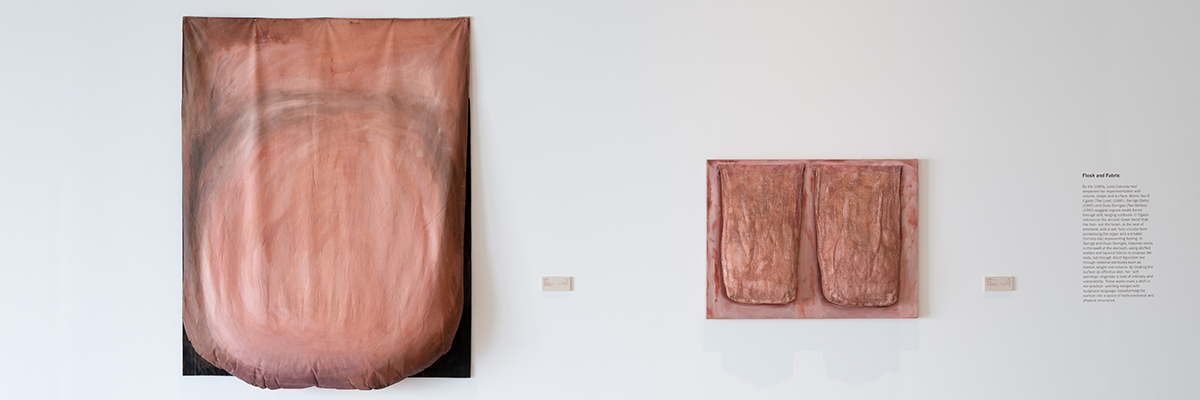
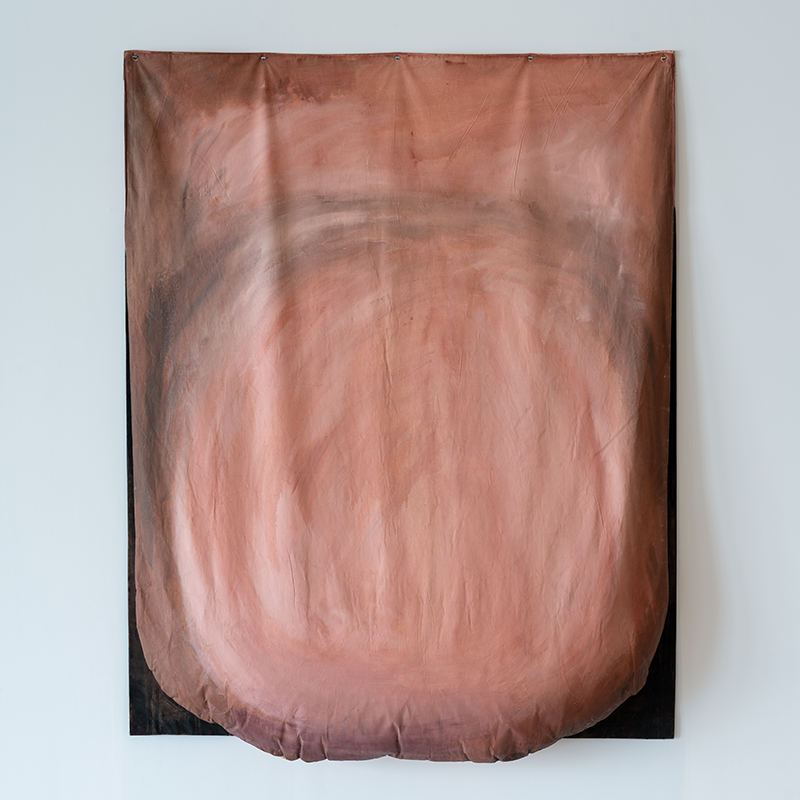
Emerging out of an era of political and social upheavals, Leda Catunda’s sculptural painting Barriga [Belly] (1993) subverts the traditional flatness of the medium. Image and object enter into dialogue, producing a soft, bulbous form that evokes the tactile intimacy of flesh–its protrusion a contrast to the inward, unseen processes of digestion. Stretching and stuffing the canvas, Catunda gives her artwork a literal three-dimensional belly that slumps forward off the wall. This is not a painting of a belly; Barriga is unapologetically physical, as if declaring: ‘I’m here, I’m heavy, I’m sagging, I’m real.’
The 1960s in Brazil began with the presidency of João Goulart, the country’s last left-wing leader before the military coup. During this period, the country’s art scene was deeply engaged in developing what has been described as a ‘populist revolutionary art’,i reflecting broader aspirations for social reform and cultural accessibility. On March 31, 1964, Goulart was ousted, and the country plunged into two decades of authoritarian rule. In the shadow of political repression and pervasive censorship—much of which was self-imposed, borne of a cautious desire for survival amid opaque and arbitrary governmental criteria—Brazilian artists found themselves forced to reinvent the very language and purpose of art. Many turned away from traditional forms such as painting and sculpture, embracing instead experimental, ephemeral modes of expression that could slip through the cracks of authoritarian control.ii Sometimes, this meant incorporating their own bodies as living materials, in addition to using degradable mass-produced materials.
The arrival of the 1980s brought the end of the military regime, infusing the Brazilian art scene with renewed energy. Freed from the imperative of ephemerality, artists returned to painting and sculpture, though now with an eye towards universal artistic languages rather than overt political propaganda.iii In 1984, the expansive survey Como Vai Você, Geração 80? (How Are You, Generation 80?), curated by Marcus Lontra, Paulo Roberto Leal, and Sandra Magge, christened a new generation of Brazilian artists. The exhibition showed a desire to return to painting.iv
An emerging artist from Sao Paulo, Leda Catunda would become one of the leading figures of the Geração 80, and its culmination of painting as a returned medium. The 1980s marked the formative years of her career, a period defined by what she terms an ‘appropriation’ of familiar images and pattern—: cartoons, hearts, suns, flowers, animals and geometric shapes, among others. Working with both handmade and mass-produced materials—fabric, towels, blankets, artificial fur, plastic, leather, even puzzle pieces—Catunda created works that deliberately blur the boundaries between painting and sculpture.v By extracting these domestic and whimsical motifs from their familiar contexts and repositioning them within new, estranged contexts, she disrupts their everyday associations, creating what is described by Fernanda Brenner as ‘semantic traps’ . The result is a body of work that invites viewers into a liminal space, in which the tension between an image’s original function and its transformed presence becomes a site of both recognition and re-interpretation.
Disrupting the everyday associations embedded in her chosen imagery did not shield Catunda’s early works from anecdotal or overly literal interpretations. Concerned by what she referred to as the ‘childish view’ often projected onto her practice, she began seeking a path towards greater intensity and conceptual rigour.vi By 1991, the recognisable patterns and motifs that once animated her surfaces had almost completely disappeared, giving way to more abstract compositions. Yet the strategy of material appropriation—so central to her artistic language—remained unchanged.
In this transitional period, forms such as bellies, tongues, insects and other hybrid or semi-abstract symbols emerged as recurring elements, replacing the earlier floral and animal patterns. These forms signaled a shift away from narrative familiarity towards a more ambiguous, sensorial expression. While her initial works resembled object-like paintings, the later pieces began to invert that relationship, presenting themselves instead as painting-like objects: autonomous forms that occupy space as much as they depict it.
In her most recent works, Catunda comes full circle as domestic patterns from her earlier pieces reemerge. Yet, these motifs now coexist with the same abstract forms and patterns that she previously sought to distance herself from. In works such as Gotas transparentes [Transparent drops] (2021) and Besouro [Beetle] (2021), for example, floral, geometric and animal patterns are applied to fabrics cut into ovoid shapes that sometimes morph into tongues, swell into bellies and slip back into tongues again.
Catunda’s 1993 work Barriga [Belly] ruminates on a pivotal moment in her artistic evolution; it marks a clear break between her earlier and later works, signaling the beginning of her process of digesting the changes around her. A stomach is a site of balance, a part that can both hurt and soothe, be full or empty. By endowing her canvas with a belly, Catunda is giving her artwork the possibility of a bellyache. In its swollen state, Barriga suggests a body that has absorbed too much and swallowed too much. In essence, the artist has given her artwork indigestion.
Like Barriga, Catunda’s stomach is at work, taking in the world around her and transforming the cultural, political and artistic upheavals of her time into forms that insist on being felt rather than merely seen. Her move beyond flatness, her embrace of textured materials, and her continual blurring of image and object all returns us to the bodily vocabulary introduced in Barriga: the bulge, the sag, the weight. In negotiating the tension between domestic familiarity and abstract expression, Catunda enacts an artistic digestion, processing memory, material and meaning. Ultimately, her work circles back to that declaration embedded in Barriga: ‘I’m here, I’m heavy, I’m real.’
i. Cláudia Calirman, Brazilian Art Under Dictatorship: Antonio Manuel, Artur Barrio, and Cildo Meireles (Durham: Duke University Press, 2012).
ii. Ibid.
iii. Ibid.
iv. O Globo. “Os 30 Anos da Exposição ‘Como Vai Você, Geração 80?’” O Globo, July 14, 2014. https://oglobo.globo.com/cultura/artes-visuais/os-30-anos-da-exposicao-como-vai-voce-geracao-80-13234802
v. Fernanda Brenner, “Leda Catunda and a Poetics of Time,” in Tempo Circular, ed. Fernanda Brenner (Rio de Janeiro: Cobogó, 2019)
vi. Ibid.
 OFF
OFF