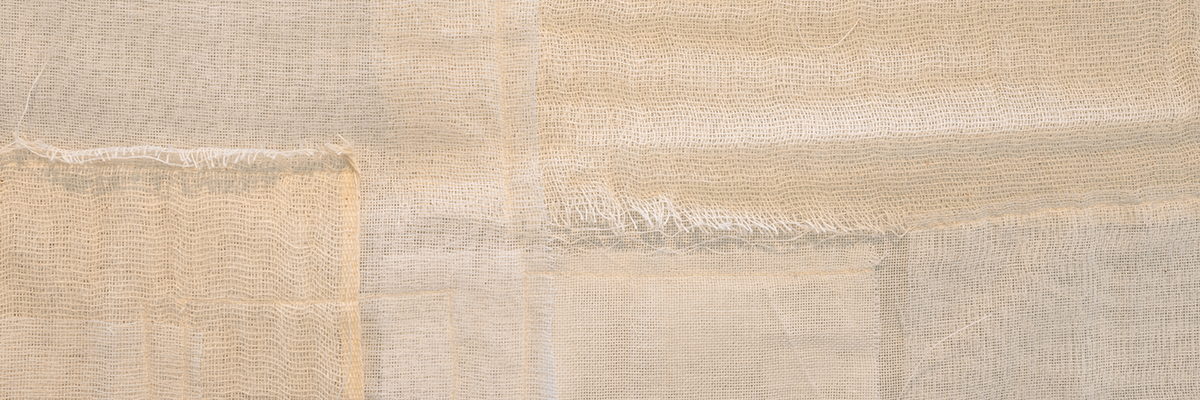
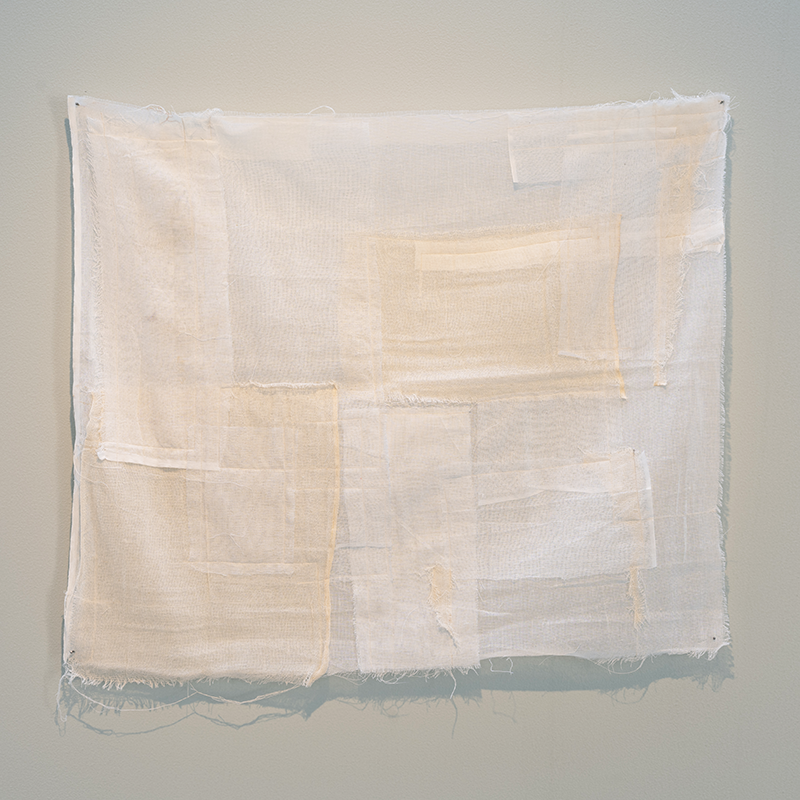
Like membranes, thin skins of white fabric are overlayed and stitched onto one another, forming an abstract field of geometric shapes. Depth gathers within a limited surface. Layers rest upon each other, one leaning into the next, throwing the degrees of white into question so that the full spectrum of the colour resists any stillness or clarity. Geometry is key here, yet it too is evasive.
Taking a cue from the children’s game, Afra Al Dhaheri’s Hide and Sew (2020) offers a play of translucency and transparency. Where one stitch appears, others recede. Some edges are clean and sharp; other are less distinct. Lightly hung or delicately pinned, the sheer white fabric hovers between flatness and depth, revealing as much as it conceals. This subtle interplay invites the viewer to peer into the fabric, questioning what could be seen and yet to be discovered.
Such playfulness might resonate with modernist art practices such as those of Yves Klein or Agnes Martin, artists who have harnessed the power of a single colour and what it can evoke. The monochrome offers a way to explore presence and absence. It draws focus onto how colour interacts with surrounding space, seemingly shifting with light, shadow and the viewer’s own movement and triggering the ‘imaginative projection’ of the spectator.i
In Al Dhaheri's exhibition Restless Circle, the artist engages the language of the monochrome through layers of fabric, rope and stitched materials. Rather than treating white as pure and formal, the artist contextualises it to reveal the quiet gestures, repetitions and emotional registers that structure everyday life. Within the exhibition narrative, Hide and Sew functions as a pause, a threshold between the act of sewing and the wider social dimensions of domesticity and visibility. Like a blank page that marks the start of a new chapter, the work opens a reflective space, inviting viewers to consider privacy, care and the intimate architectures that shape the artist’s context.
Hide and Sew demands attention through subtlety rather than overt gestures. At first glance, the work appears as a fragile cotton mesh of layered stitches. Yet it moves beyond the surface, concealing and revealing ideas rooted in memory, domesticity and the cultural rhythms of the Gulf. Privacy and permeability are key to domestic architecture in this region. In this sense, Hide and Sew performs a role similar to that of the courtyard of the traditional house.
The courtyard anchors the house spatially. It serves as an open threshold mediating between private and public realms, directing the gaze and structuring circulation within the household components. Surrounded by thick exterior walls that ensure privacy, the courtyard establishes a controlled relationship between inside and outside, forming what could be described as an introverted open space.ii
These houses are typically conceived with degrees of privacy in mind. The most public spaces align with the street, then lead inward toward increasingly private areas. Gendered spatial divisions and social boundaries become evident in this progression: the majlis, a male-oriented reception space, is often positioned as a separate unit toward the exterior, while women’s spaces are situated deeper within. Navigating the home involves passing through a sequence of thresholds – the courtyard, corridors, curtains, textile partitions and shaded passages – all of which regulate movement and determine who sees what and when.iii
Through this lens, the work reflects the social choreography of visibility that shapes Gulf interiors, balancing hospitality with discretion, openness with care. Concealment here is never absolute. The layering allows light to pass through, suggesting that privacy is a continuous negotiation between openness and protection. It invites the viewer to consider how cultural expectations determine what is made visible and what remains hidden, mirroring how individuals navigate these codes in daily life.
Al Dhaheri embraces this ambiguity through her material: translucent cleaning rags, found in every household. By foregrounding the process of making, the artist turns time itself into a material: each stitch becomes a temporal mark, a gesture of care carrying intimacy and rhythm. The repetition within her work feels meditative rather than mechanical, mirroring the negotiations, emotions and unseen labours that unfold within domestic spaces. The artist manages to draw out an activity traditionally practiced in the most private realms of the home and effectively turn it inside out. In this sense, her practice aligns with a lineage of women artists – from Louise Bourgeois to figures such as Etel Adnan, Samia Halaby and Mona Hatoum – who have turned to textile to challenge the gendered hierarchies of art production. Long dismissed as craft and confined to the interior sphere or to regional traditions, sewing and needlework nonetheless hold a radical potential that Al Dhaheri’s work quietly yet powerfully reactivates.
Hide and Sew carries this radical potential of care labour in its most simplified movements: stitching, layering and folding. It transposes these gestures onto the geometric grid, a construct that ordered the earliest modernist monochromes. On first encounter, the piece appears minimal, almost restless, yet it is this fragility that anchors the work. By placing the act of sewing within the visual language of abstraction, Al Dhaheri addresses the unsettled separation between ‘feminine’ domestic work as craft and the supposed neutrality and experimental materiality of modernist form.
i. Hay, Kenneth G. ‘Unpacking the Monochrome: Some Reflections on Muteness in Art.’ Interfaces. Image-Texte-Langage 9, no. 1 (1996): 31–44.
ii. Al-Mohannadi, Asmaa Saleh, and Raffaello Furlan. ‘The Spatiality of the Vernacular Courtyard House in the Arabian Gulf Region.’ Heritage 8, no. 7 (2025): 268. https://doi.org/10.3390/heritage8070268.
iii. Ibid.
 OFF
OFF