By Nada Ammagui
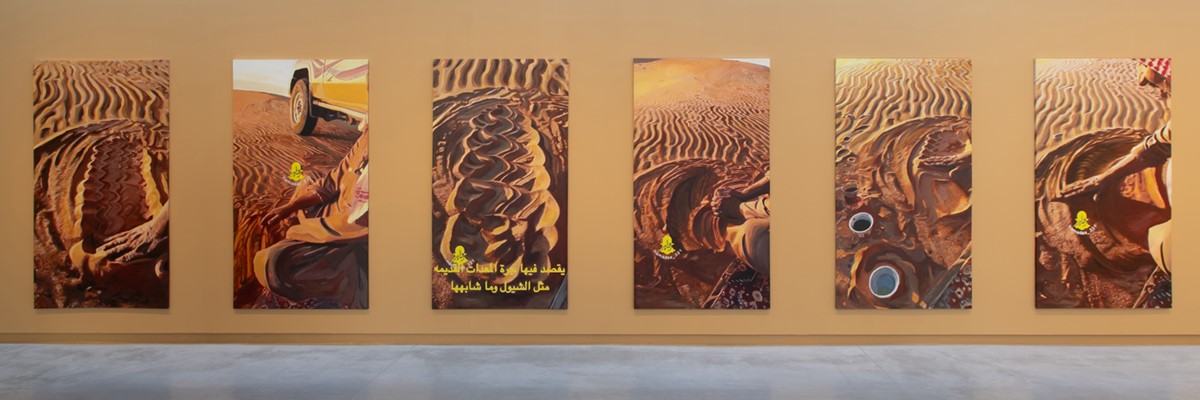
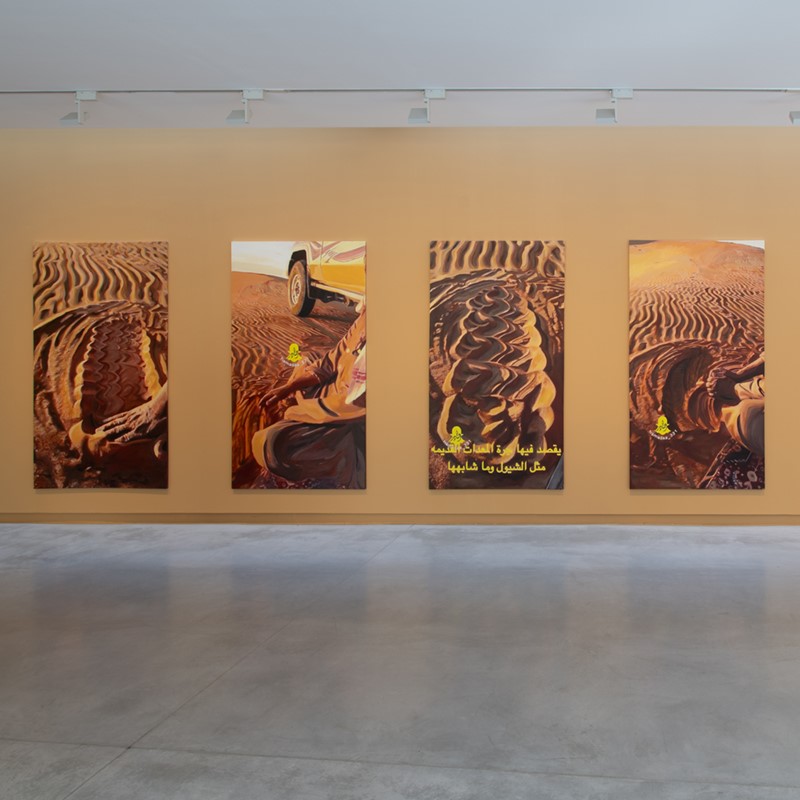
Painted across six dune-coloured canvases, Ahaad Alamoudi’s Tyre Mark (2025) captures layered and disjointed scenes from a video that was circulated widely on social media. The polyptych, commissioned by the Sharjah Art Foundation, shows a man expertly tracing the tread marks of various kinds of cars, flaunting his knowledge of the vehicles and the dunes themselves as he decodes the differences in the patterns left behind in the sand. Surrounding him are visible cues of a desert outing: a beige-and-red four-by-four; the half-filled gahwa cups, symbolic of Khaleeji hospitality and tradition; rippling dunes; and, notably, the bright yellow, animated ghost of the Snapchat logo. Alamoudi encountered this video not in its original form, but as a reproduction shared on a second platform. She took screenshots of various scenes and printed them onto canvases before painting over them. This intricate process of visual compounding blurs the lines of ownership and what constitutes the public domain in the age of image circulation on social media, while also incorporating symbols of this digital era into the visual fabric of everyday life in the Gulf.
The historical and contemporary Gulf, cultural symbology, and digital media are not new subjects for one of Saudi Arabia’s most prolific emerging artists. Within her practice, Alamoudi frequently mobilises humour to consider the role of cultural symbols—among them, falcons, dunes and traditional music—in shaping and defining narratives around Saudi identity during a time of accelerated transformation along urban, social, economic and political registers across the Gulf region.
Her approach to grappling with the change around her is on full view in the two-channel video installation WHAT IS THIS?! (2026), which featured in Sunkissed, the artist’s solo exhibition at Sharjah Art Foundation. Much like the new lives and meanings that social media content adopts as it journeys through vast webs of digital networks, the backdrop in WHAT IS THIS?! is reworked by Alamoudi for different exhibitions to reflect the contexts and contours of these shows. In the Sunkissed edition, two animated falcons stand back-to-back against static treaded sand dunes. They respond to one another in stilted, puppet-like movements as they react—and struggle to adapt—to shifts in their environment and the world around them. A sense of boredom and longing for change pervades their dialogue. Drawing on the significance and endurance of falcons within regional cultural histories, WHAT IS THIS?! is emblematic of Alamoudi’s method of situating the present within the past and future; traditional symbols meet contemporary media to probe the current moment. Facing off against Tyre Marks, WHAT IS THIS?! draws on the landscapes that traverse the peninsula to connect the narratives of temporality and tradition central to her artistic practice. The artist’s rich colour palette of sand-dune browns, sunset yellows and oranges, and pomegranate reds further conveys the vibrancy and energy of the generation at the heart of this change.
Materially, Tyre Mark sits between a digital screenshot, a photographic series and a painted still-life. The ambiguity of the work’s medium echoes the complexities of the digital landscape it references. Added onto the original video, descriptive subtitles and proprietary watermarks evidence the interpretation, manipulation and reclamation of the tyre mark performance by additional creators seeking to appeal to new audiences. Though the video’s chain of circulation is unclear, every additional layer and trace of transmission through a different social media platform—watermarks, text, granularity and the loss of resolution—creates distance from its producer and owner. This further complicates the relationship of the videos’ (and later the photos’ and paintings’) contents to their original creator. Alamoudi takes this concept one step further by bringing the video into an analogue medium and physical space. She paints over the frozen scenes, cementing these particular moments in time and incorporating them into her own world.
Beyond the allusions of Tyre Mark to its online origins and the intricate chain of digital circulation, the paintings make direct reference to the symbols that occupy Alamoudi’s creative imagination: desert four-wheelers, sand dunes and the like. However, the artist also introduces a new visual object: the yellow ghost logo of the private messaging and photography application Snapchat. Launched in 2011, Snapchat boasts nearly one billion active monthly users worldwide. In the MENA region, the application sees particular popularity. Saudi Arabia alone has the fifth largest user base worldwide, with nearly 25 million users and a 90% penetration rate among 13-34 year-olds. In the United Arab Emirates, about one in three 18-34 year-olds uses Snapchat.
The platform’s executives explain that ‘[Snapchat] is a natural digital extension for GCC locals–mimicking their life interactions.’ The platform’s ‘ephemeral messaging, privacy controls and a focus on genuine connections with close friends, family and people with influence’ appeal to its GCC userbase, enabling Snapchatters to send updates and post content privately without the pressures of a publicly-visible profile. ‘They love the fact that it gives them a way to maintain their connections, in a private place where they can be themselves with no pressure…’ The platform’s emphasis on discretion–particularly through features like disappearing messages and notifications when other users screenshot content–aligns with the cultural values of many of the region’s Snapchat users, cementing the application’s prominent position among social media apps in the GCC.
In Tyre Mark, a Snapchat user’s yellow ghost watermark reads ‘hamadaa_331,’ referring to a user who calls himself 'الرحاله النادر’, or ‘the rare traveler’. In its original format, this ghost bounces around the video as a watermark. Alamoudi mimics this dynamism by freezing the icon at various points within her frames. Through this gesture, she draws a neat comparison between the ephemerality of content shared over Snapchat and the impermanence of the tyre marks and the shifting sands of the desert. To witness these tread marks and this video is to live within a particular moment captured and shared by the video’s producer. And yet, Alamoudi subverts its temporariness by affixing this scene–or rather, a very specific instance and occurrence of this scene–onto a canvas. As the protagonist wipes away each tyre pattern, what becomes clear is that, oddly enough, the opportunities for renewal presented by the desert and the digital landscape are not unlike one another; erasure enables change, and change offers the promise of a new future.
 OFF
OFF