By Yalda Bidshahri
Against the backdrop of war, I have found myself drawn to the sea, to the desert, to the mountains. I feel an urge to be with something larger than the immediacy of the situation. As I think about the ways in which patriarchy, with all its violence, promises salvation, I know that ultimately it is the Earth that carries forward the force of life through its natural rhythms.
Within this frame of mind, I journeyed to Kalba Ice Factory, located in a scenic town nestled between the Gulf of Oman and the Hajar Mountains on the east coast of the Emirates. Originally a fish feed mill reoutfitted as an art space, the gallery is currently host to Of Land and Water: Works from the Sharjah Art Foundation Collection. The exhibition draws its theme from the Malay word for homeland, tanah air, which binds land and water into a single notion of belonging that resists the rigid separations imposed by geographic borders and political statehood. Water, in particular, flows across these lines, carrying with it histories, mythologies and forms of knowledge that cannot be contained.
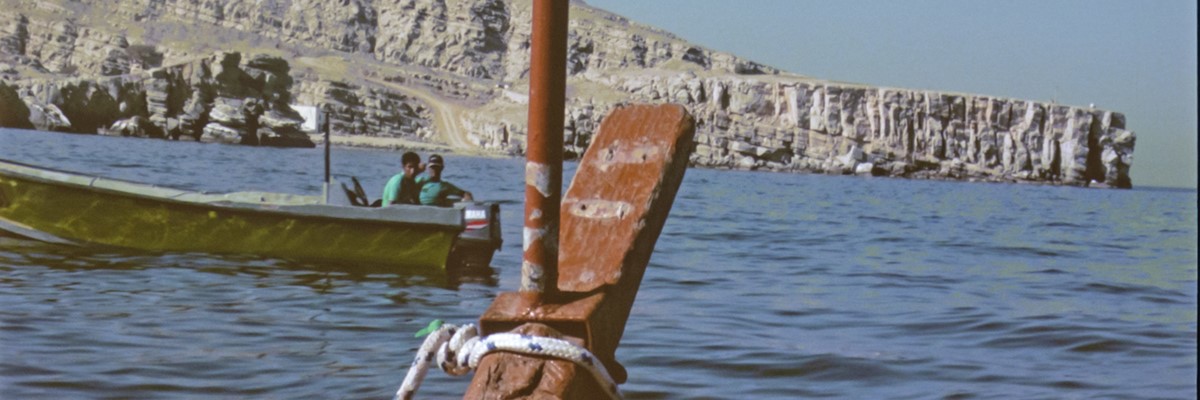
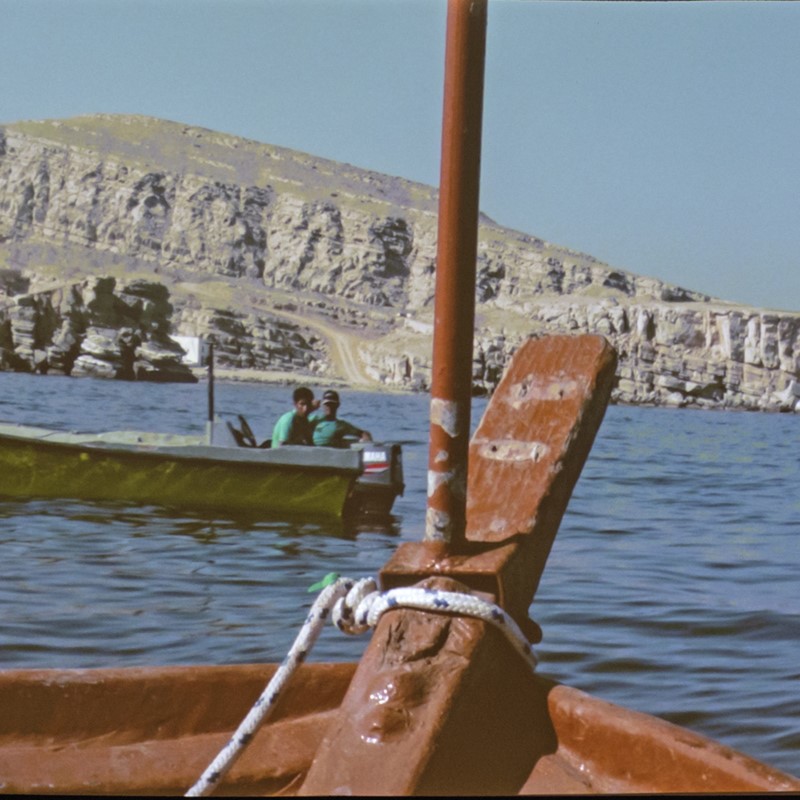
Situated within a semi-enclosed, cavelike viewing area, Babak Afrassiabi and Nasrin Tabatabai’s video work Plate It with Silver (2015) traces these transits along the Strait of Hormuz. Water appears throughout the film as a surface of sustained attention. The camera often remains still, allowing its calm and gentle movements to unfold within the frame, its colour often blending with the sky. The duration of these shots alters the pace of looking, drawing the viewer into a slower register. The film pulls you in and holds you there, as if you are floating along the small lazy waves.
Dhows pass across the hazy horizon, unhurried, between Iran, the UAE, Qatar and Oman. At the water’s edge, boats press into the shore as figures wade through the shallows to greet them. Packed goods get passed from hand to hand in a continuous exchange. In one moment, a man in a suit jacket is hoisted on another’s back, lifted clear of the water as they make their way inland. Here, Afrassiabi and Tabatabai focus on the often overlooked yet essential labour that underpins these crossings. All along the Strait, goods circulate through informal economies, carried by those whose knowledge of the sea is not measured by instruments. At one point, someone behind the camera asks a couple of young men on a boat: “Do you use a compass?” The answer is no. They have passed through these waters so many times, they know them by heart.
The film is layered with other such field recordings in Farsi with those who inhabit these shores. Their voices drift in and out of the image, at times connected to what is shown, at others only vaguely in relation. These citations offer fragments of explanation, guiding without fully fixing what is seen.
Alongside shipments of fuel, fish, clothing and cigarettes, other forms of circulation emerge. The film traces the presence of ‘winds’ that move across historic trade routes. Like the sea, the winds resist containment. They are said to enter the body and then remain, calling for offerings like turquoise rings, trays of sweets or silver-plated rattan sticks (the making of which lends the film its title). The story goes that these spirits were first observed among pearl divers, before they spread through the communities along the Gulf.
In scenes on land, Afrassiabi and Tabatabai tease out a history of these spirits, pieced together through rituals, workshops and conversations with possession priests. One man describes how the wind might notice you walking along the street and fall in love with you. He says that what begins as something one-sided can, over time, become mutual. As he explains, other beings like jinns and faeries may leave, but the winds stay. Carried across generations and geographies, these forces resist diagnosis and demand forms of care that lie outside institutional medicine. They can only be negotiated with and soothed. People have learnt to live with them.
In other shots, the film turns to painted murals on street walls showing birds in flight, ships gliding across the water, and traditional houses marked by windcatchers. At one point, a voice recounts how a young woman fell ill, her condition attributed to the wind. ‘They’re found wherever there is the sea,’ the speaker explains. While they are ‘not static enough to be visible,’ these winds have names and distinct identities. They are recognised as presences, and it seems as if they have a place in society. Possessed individuals are called ‘people of the air’, as if in distinction to the people of the land and sea.
Another voice compares this state of possession to a sensation akin to going under anaesthesia, like a lapse in memory. ‘When I became conscious,’ he says, ‘I had a white cloth over my head. I was holding a rattan stick and wearing a silver ring.’ He traces the wind back to an encounter in Dubai, speculating that it was passed on to him by an Omani woman— something without precedent in his family. He speaks of illness and swelling that would only worsen under medical treatment until, after a series of rituals, his condition began to finally ease. Throughout, Afrassiabi and Tabatabai train their cameras on the murals, lingering on painted images of mountains, sun and the open sea as the narratives describe the forces passing through them.
From smuggling routes to acts of possession, Plate it with Silver unfolds a system of exchange that vacillates between the material and immaterial. In the current moment, the same waters are a site of tension and blockage. And yet, within the film, the Strait appears as a field where the movement of life has continued across generations and geographies despite boundaries. In a present defined by destruction, uncertainty and fear, I find comfort in turning towards the Earth, towards its waters, and toward the winds which course through and beyond us. It gives me hope to remember that despite every attempt to control it, life can never be fully contained.
 OFF
OFF